So here’s the thing about buying bees as a birthday present for an eleven year old.
Bees do not care about your schedule.
The plan was simple. Bee Girl’s grandparents were getting her a colony of bees for her birthday. It was going to be brilliant. The old wives’ tale says you should never buy your own first bees, they should be gifted to you, and the grandparents weren’t about to argue with centuries of beekeeping tradition. (Whether they already knew about the superstition or whether we told them about it afterwards and they said “oh yes, that’s definitely why we did it” is a matter of family debate.)
Now, this old wives’ tale? It turns out it’s not just an old wives’ tale. It’s the tip of an absolutely enormous iceberg of bee folklore that goes back thousands of years, involving everything from ancient Irish law to Greek priestesses to the Royal Beekeeper telling the bees when Queen Elizabeth died. We’ve written a whole separate post about it because honestly, once we started reading about it, we couldn’t stop.
But bees aren’t like a book or a pair of trainers. You can’t just pop into a shop and pick up 50,000 of them on a Tuesday. Nucleus colonies, which is what you get when you’re starting out (a small, established colony with a laying queen, some frames of brood, and enough bees to get going), are ready when they’re ready. Nature decides. Not your birthday calendar.
So Bee Girl’s birthday came and went, and instead of a box of bees, she got a card that basically said “your bees are coming, we promise, they’re just not ready yet.”
She took it surprisingly well. Better than I would have, to be honest.
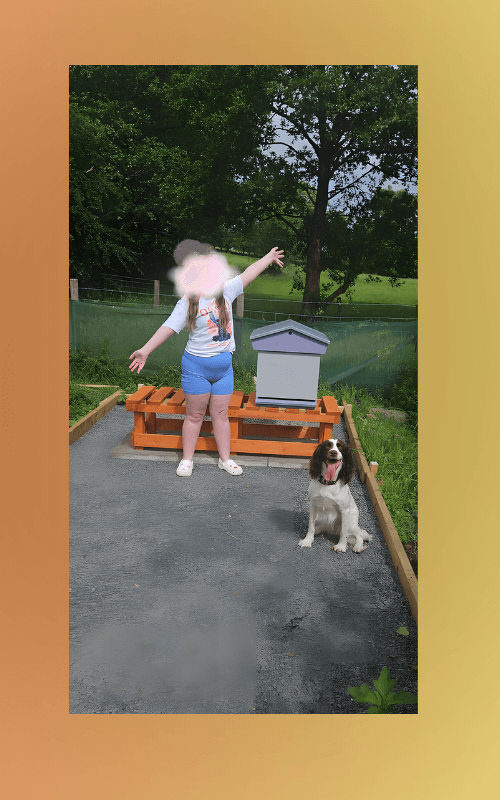
And then, when the bees were finally ready… we had a problem. Specifically, the problem was us. We’d done the course. We had the suits. We had the hive. But we had absolutely no idea what to do with actual living bees. The gap between “learning about bees in a classroom” and “keeping bees alive in your garden” felt enormous.
Enter our mentor.
The Woman Who Stopped Us From Panicking
I cannot overstate how important this bit is, so if you’re a beginner reading this and thinking about getting bees: find yourself a mentor. Seriously. Do it before you do anything else.
Ours is a friend of Bee Girl’s grandparents. She keeps bees herself and she’s a member of our local beekeeping club (Randalstown & District Beekeepers Association), though the club didn’t formally arrange the mentoring. It was more of a “right, you two clearly need help, I’ll keep an eye on you” situation. Which is exactly what we needed.
The plan became: instead of bringing the bees straight to our house, they’d stay at our mentor’s apiary for the summer. That way, we could learn alongside someone who actually knew what she was doing. We could make our mistakes with someone standing next to us going “no, not like that, like this.” We could build up our skills and our confidence before we were on our own.
It was the best decision we made.
Summer at the Apiary
Every visit to our mentor’s was like a mini masterclass. She had this way of making everything feel manageable, even when we were standing in front of an open hive with bees flying everywhere and I was internally screaming.
She got Bee Girl holding frames almost straight away. Proper frames, full of bees, right there in the hive. Bee Girl was brilliant at it, as she is with most things bee related. But our mentor also taught her the most important thing: be quicker.
Because here’s what nobody tells you in the classroom. When you open a hive, you’re disrupting the bees’ entire day. They don’t love it. And the longer you take, the grumpier they get. So those first few inspections where we were slow and hesitant and checking everything three times? The bees let us know about it. Nothing dramatic, just that low, rising buzz that says “could you please hurry up?”
Bee Girl got faster. I got… less slow. Our mentor kept us right with everything: how to feed them, when to heft the hive to check their stores, what treatments they needed and when. All the practical stuff that turns course knowledge into actual beekeeping.
Without her, I honestly don’t think I’d have had the confidence to keep going. It’s one thing to read about what to do. It’s another thing entirely to do it with someone beside you saying “you’re doing fine, keep going.”
Finding a Mentor: What We’d Tell Other Beginners
If you’re starting out, here’s what we learned about finding a mentor:
Your local beekeeping association is the best place to start. Some clubs have formal mentoring programmes where they’ll pair you up with an experienced beekeeper. Others are more informal, but most beekeepers are incredibly generous with their time and knowledge. They remember what it was like to be new. They want you to succeed.
Ours happened to be a family friend, which made it easy. But even if you don’t know anyone, ask at your local club. Turn up to meetings. Be honest about being a complete beginner. People will help. Beekeepers are, in our experience, some of the nicest people you’ll ever meet. (Possibly because they spend so much time around bees. Possibly because they all remember the terror of their first inspection.)
The key thing is: don’t try to figure it all out on your own. The course gives you the knowledge. A mentor gives you the confidence. You need both.
The Summer We’ll Never Forget
That summer was magic. Every visit to the apiary was an adventure. Bee Girl with her face pressed up against the frames, counting bees and spotting brood and announcing things like “Mum, look, that one’s doing a waggle dance!” Me, trying to look calm while internally wondering if I’d zipped my suit up properly.
We learned so much that summer. How to read the brood pattern. How to check the stores. How to light the smoker without setting fire to anything important. How to move through the hive with purpose instead of panic.
But it wasn’t all smooth sailing. Because somewhere in the middle of that summer, something happened that would have sent us into a complete spiral if we’d been on our own.
Our queen absconded.
But that story? That gets its own post. Because honestly, you need a cup of tea for that one.
The Good, The Bad, and The Sticky:
Good: We found a mentor who kept us sane, our confidence grew every single visit, and Bee Girl turned out to be a natural with the frames.
Bad: The bees missed Bee Girl’s actual birthday by quite a bit. She had to make do with a promissory note from her grandparents and a card with a bee on it.
Sticky: The first time I tried to use the hive tool to separate two frames that were stuck together with propolis. Nobody warned me about propolis. That stuff is basically bee superglue.
Mum
Bee Happy Honey
Northern Ireland
P.S. Bee Girl says her birthday present was “worth the wait” and that “not many people can say their grandparents bought them fifty thousand pets.” She’s not wrong.
P.P.S. She’s also asked if she can have a second hive for her next birthday. I’ve told her to ask the bees, not me.
🐝 Keep Reading
Related: the gear we bought before the bees arrived and what happened when our queen absconded.