A mother-daughter beekeeping adventure
Right. Pull up a chair. Get the kettle on. I need to tell you about this talk, because it properly changed how we think about our bees.
So there I was at the UBKA Annual Conference, sitting in the lecture hall with my phone out trying to record everything, scribbling notes like a woman possessed. Bee Girl? Bee Girl was off at the workshops making candles and skincare products and having an absolutely brilliant time without me. Classic Bee Girl.
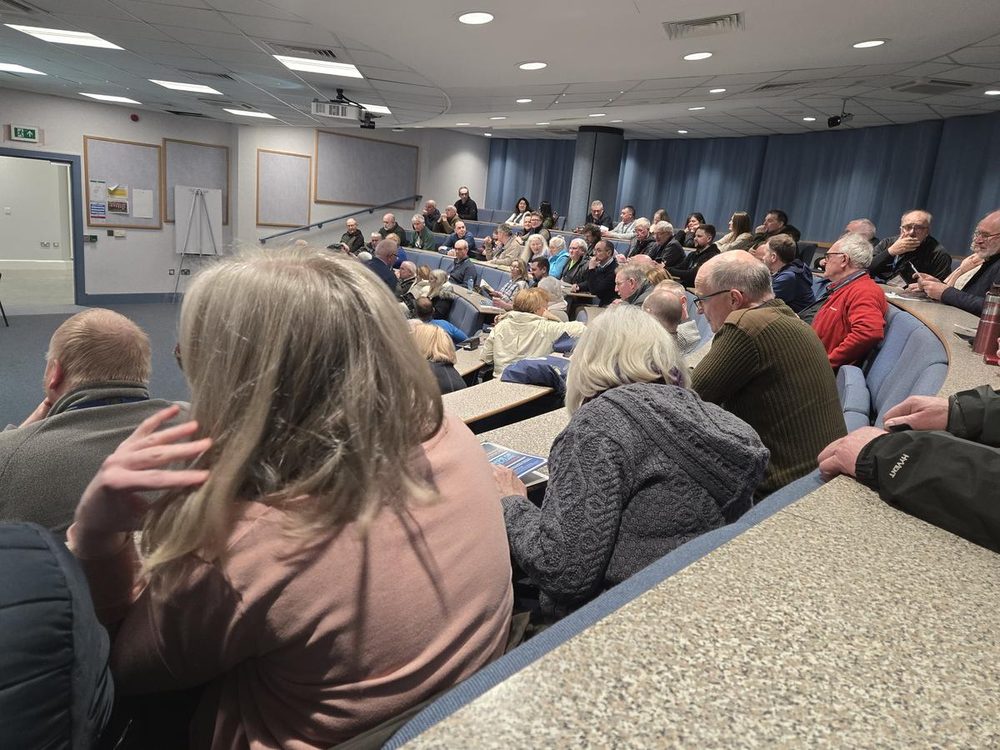
Professor Grace McCormack from the University of Galway stood up to talk about our native Irish honey bee. The dark bee. Apis mellifera mellifera, if you want to get fancy at your next dinner party. And honestly? By the end of it I was sitting there trying not to cry in a room full of beekeepers.
Because here’s the thing. We have one hive. One colony. We still haven’t found our queen to mark her (don’t judge us, she’s fast). We are, by any measure, two people with absolutely zero idea what we’re doing.
But the bees in our hive? They are 8,000 years of Irish stubbornness packed into a tiny fuzzy body.
Eight. Thousand. Years.
Bee Girl, when I told her all this in the car home, thought about it for a second and said: “So our bees are basically ancient?”
Yes, love. Our bees are basically ancient.
They Fly in the RAIN, People
OK so Professor McCormack’s team at Galway has spent years properly studying what makes our native bees different from imported ones. Not a vague “oh they’re a bit darker.” Actual science. Measurements. Statistics. The works.
And the very first thing on the list made the whole room smile, because it was SO Irish.
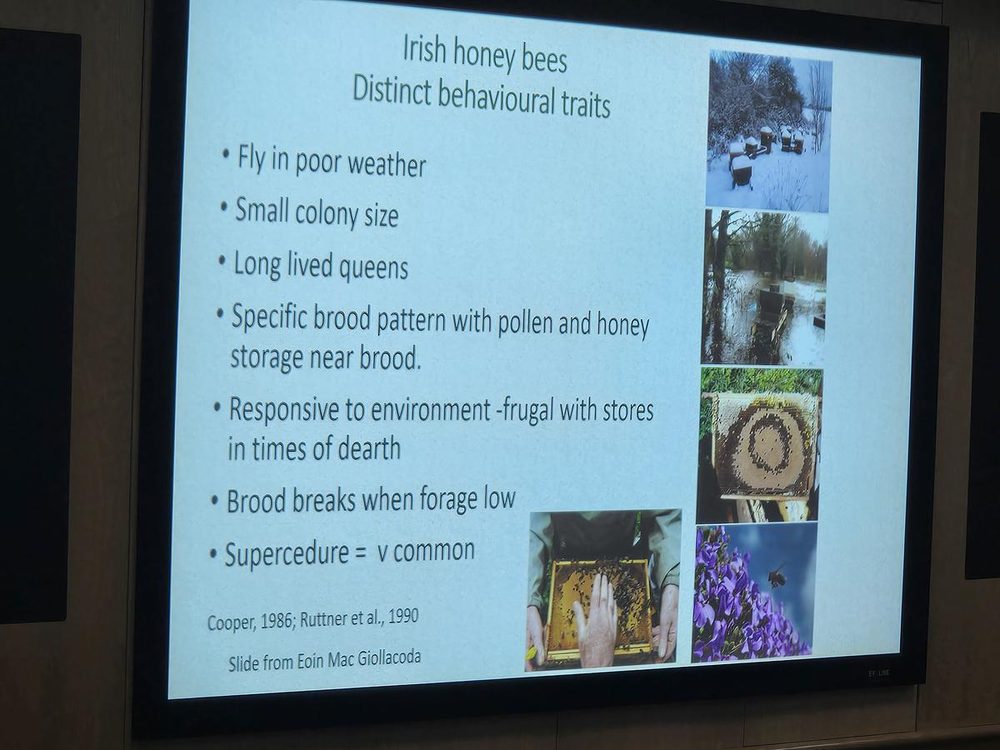
Our bees fly in terrible weather.
Rain. Wind. Cold. The kind of miserable February afternoon where you wouldn’t send the dog out. McCormack’s team has watched these bees heading out to forage in conditions where imported bees from warmer countries just… don’t. They stay home. Ours pull on their wellies (metaphorically) and crack on with it.
If you’ve ever experienced an Irish summer, you’ll understand why this matters. If our bees waited for good weather, they’d starve by June.
Tiny Irish Woolly Jumpers (Yes, Really)
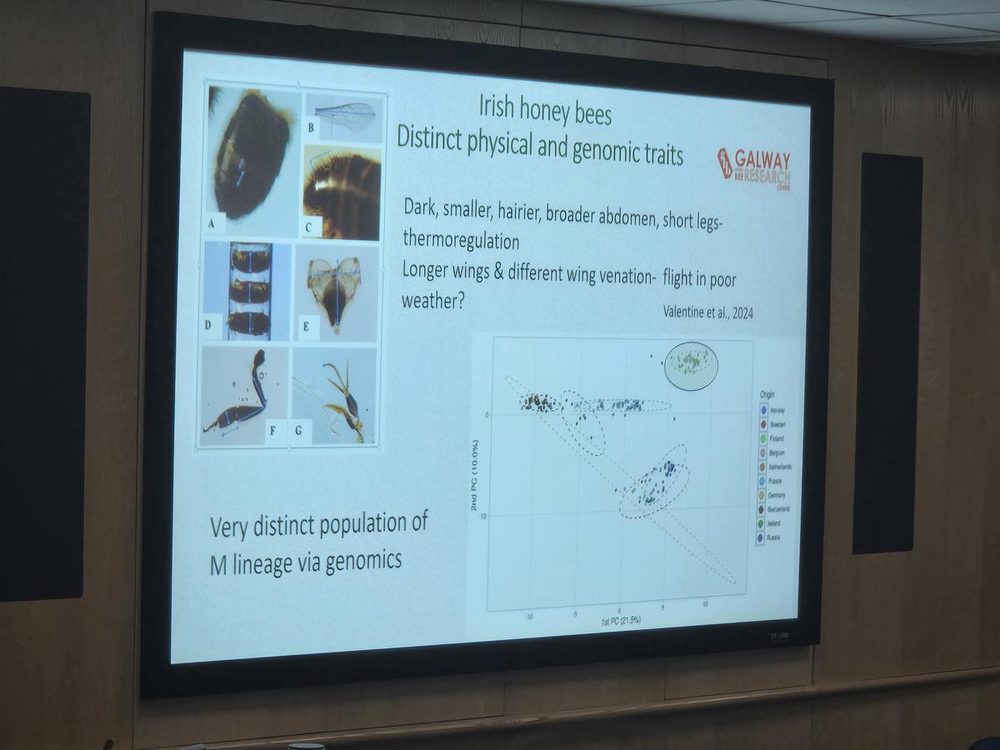
This is where it got properly fascinating. McCormack’s team measured over 100 bees per colony across 30 pure native colonies and compared them to other populations. Our bees are physically different. Shorter legs. Denser hair. Broader tummies. Longer wings. And all of it statistically significant.
Now. I am not an engineer. But McCormack discussed these findings with a mechanical engineer who studies how bees keep warm, and his take was that shorter legs plus denser hair plus broader bodies means a tighter winter cluster. The bees can pack in closer together and keep each other warmer during those long, dark, freezing months.
When I tried to explain this to Bee Girl, she thought about it and said: “So they’re wearing tiny Irish woolly jumpers?”
And honestly? That’s going on a t-shirt.
The Wild Ones (This Bit Made the Room Go Quiet)
Here’s something that completely surprised us.
In most European countries, there are hardly any wild honey bee colonies left. In some places they’re actually destroyed because people think they’ll spread disease to managed hives.
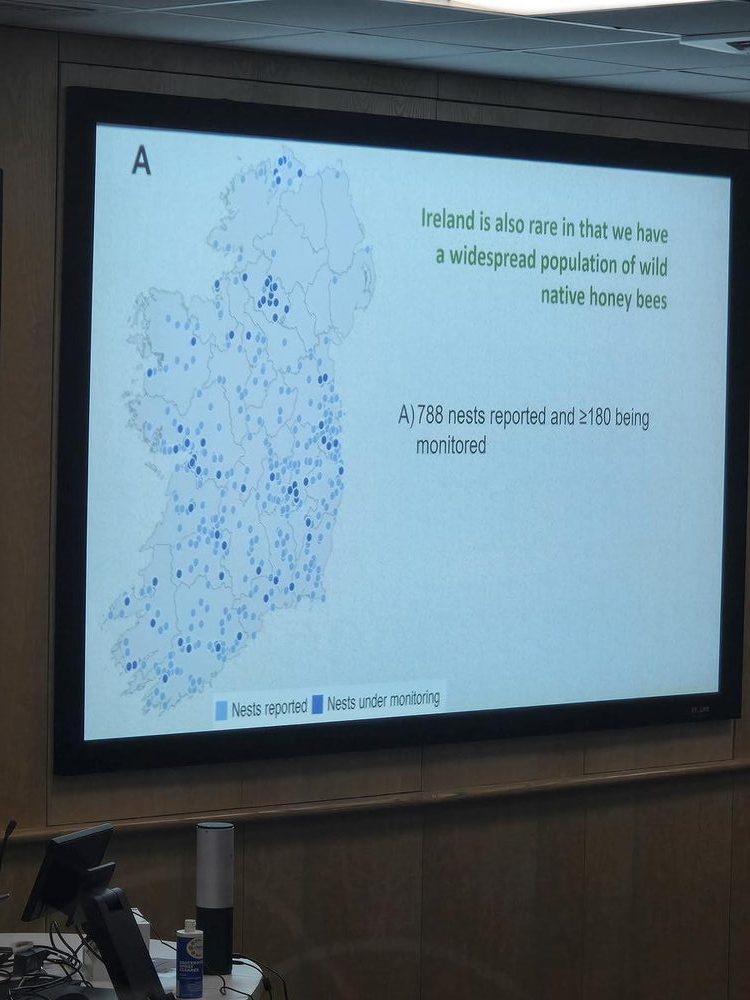
Ireland? We have 788 wild nests reported across the country. At least 180 of them are being actively monitored by McCormack’s team and about 100 citizen science volunteers. These bees are living in trees, old buildings, walls, chimneys. No beekeeper. No treatment. No feeding. Nobody worrying about them at all.
And here’s the bit that got me.
Using DNA analysis to track queen lineages over time, the team has confirmed that some of these wild colonies have maintained the same family line for at least five years. Five years! That’s great-granddaughter queens still living in the same spot their great-grandmother set up home. Generation after generation of Irish bees, surviving completely on their own, in Irish weather.
Oh, and before anyone panics: there’s no significant difference in disease levels between wild colonies and managed ones. They’re not a risk to your hives. Important to know.
The Bit About Buying Bees on the Internet
OK. Deep breath. This is where it gets scary.
Before 2020, more than 97% of Irish colonies tested were pure native dark bees. Ninety-seven percent! Our girls were doing brilliantly.
Then COVID happened. People took up hobbies. Some of them discovered you could buy bees online. And the import numbers, which had been fairly steady for years, went through the roof. McCormack put up a graph and you could actually hear the sharp intake of breath around the room.
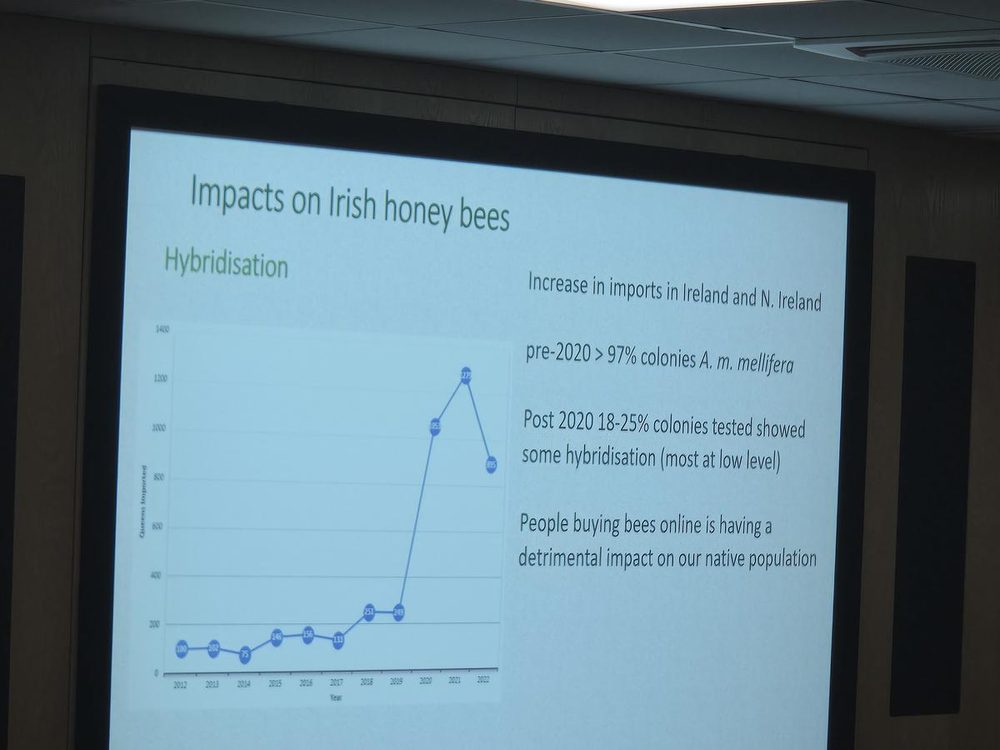
Since 2020, 18 to 25% of colonies tested now show some hybridisation. And here’s why that’s not just “a bit of mixing”: our native bees and the commonly imported types have been evolving separately for over 200,000 years. TWO HUNDRED THOUSAND YEARS. When you cross populations that different, the offspring can actually end up worse off than either parent. Scientists call it outbreeding depression, and it’s a real problem.
McCormack’s modelling suggests that at recent import levels, we could lose our native bee within 50 to 75 years.
Eight thousand years of evolution. Gone within our grandchildren’s lifetime. Because people bought bees on the internet.
Bee Girl’s response to all of this? “Why would you buy bees on the internet? That’s weird.”
Bee Girl. Cutting through the science since 2014.
The Irony That Made Us Both Laugh (Sort Of)
OK here’s the bit that really got us.
One of the reasons people import bees is because they think black bees are aggressive. McCormack’s answer? They’re not. Our bees just haven’t been through the same intensive breeding programmes for calmness that some imported strains have. Most of them are perfectly fine.
BUT. When you cross native bees with imported bees? The hybrids can actually be MORE aggressive.
So people are importing bees to get calmer bees… and creating angrier bees.
You could not make it up.
A Wee History Lesson (Bee Girl’s Favourite Part)
We couldn’t skip this bit because Bee Girl has been trying to pronounce “Bechbretha” for three days now and it’s been hilarious.
The Bechbretha were ancient Irish bee laws, part of the Brehon legal system, covering everything from who owned a swarm to how honey should be shared if a colony ended up on your neighbour’s land. The town of Clonmel comes from “Cluain Meala,” meaning “Vale of Honey.”
Bees are literally woven into the names and laws of this country. And they’ve been here since the Ice Age. They walked (well, flew) in roughly 8,000 years ago when the ice melted and the treeline moved north.
Oh, and here’s a detail that properly stuck with me. You know Buckfast bees? Created by Brother Adam at Buckfast Abbey because he thought native bees were extinct? Buckfast Abbey itself has stopped using Buckfast bees. They’ve gone back to their local native subspecies.
If that doesn’t make you stop and think, I don’t know what will.
“But Are Imported Bees Not Better Though?”
Nope. And McCormack had the receipts.
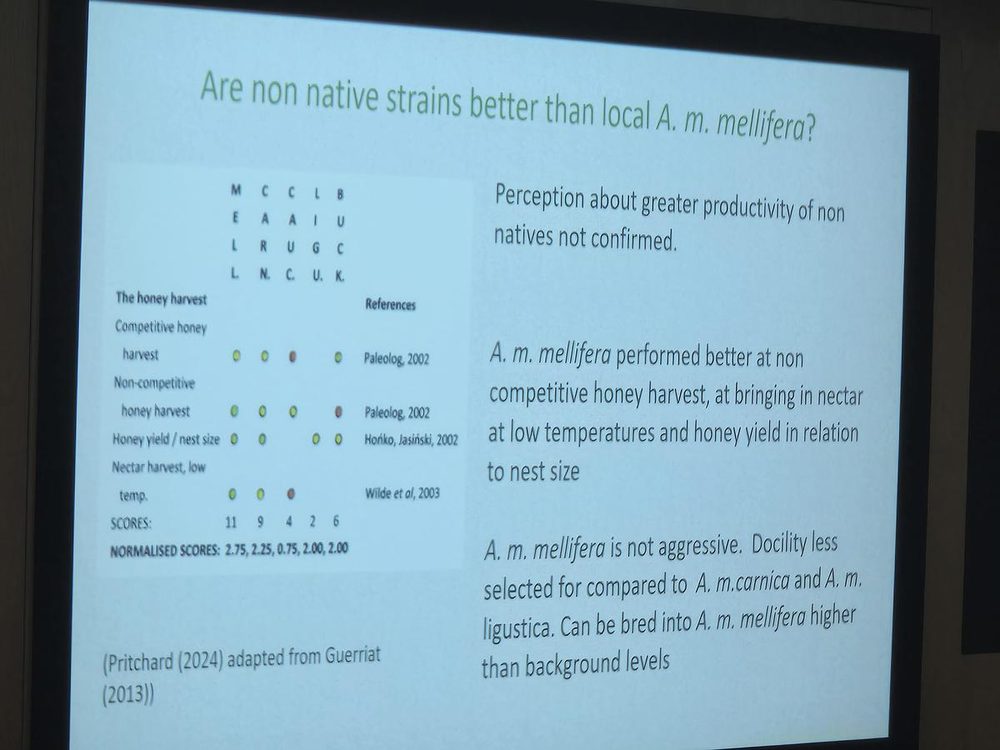
Research shows our native bee outperforms imported subspecies at harvesting honey in non-competitive conditions, at bringing in nectar in cold temperatures, and (this is the really good one) at honey yield relative to colony size. Meaning our smaller native colonies produce proportionally MORE honey than bigger imported ones.
Smaller colonies. More honey per bee. In worse weather. While flying in the rain.
I mean. Come on.
What Can We Actually Do?
There’s real momentum building to ban non-native bee imports in the Republic of Ireland. McCormack said the political support is unprecedented, with all parties on board, which apparently never happens. There’s also a push to close a Northern Ireland import loophole.
But while that works its way through, McCormack’s message was simple: buy local. Support your local beekeeping association. Support local queen rearing programmes. Don’t buy bees from random websites. And if you spot wild colonies, report them, because the research team wants to know about every single one.
Our Takeaway
We walked into that lecture as two beginners who knew they had “black bees” in their hive. We walked out understanding that what we have is something genuinely special. Eight thousand years in the making. Adapted to this island, this weather, this life.
We still can’t find our queen. We’re still making it up as we go. We’re still the beginners who panic and ring someone from the club at the first sign of anything unusual.
But our bees have survived Ice Ages and population crashes and a monk who thought they were extinct. We reckon they can probably survive us too.
Professor McCormack’s final message? Teach the beginners. Don’t lose what we have.
That’s us. We’re the beginners. And we are very much listening.
This post is based on Professor Grace McCormack’s talk at the UBKA Annual Conference 2026. All research and data referenced is from McCormack and her team at the University of Galway. Any mistakes in translating “serious science” into “two beginners who got emotional in a lecture hall” are entirely ours.
Want to dig deeper? Key references: Cooper (1986), Ruttner et al. (1990), Valentine et al. (2024), Pritchard (2024). Links: pollinators.ie, nbdc.ie
Got wild colonies near you? The research team wants to hear from you! And if any of this surprised you as much as it surprised us, let us know in the comments.
Bee Happy. Bee Informed. Bee Native.