
BEE HAPPY HONEY | The Bee Garden | July
July in the bee garden: lavender, borage, and the summer moment when everything finally comes together.
We bought lavender at Galgorm in March and within about forty minutes of getting home it was planted in a honey pot by the apiary. We were not entirely sure how long it would take the bees to find it.
The answer, it turned out, was approximately one afternoon.
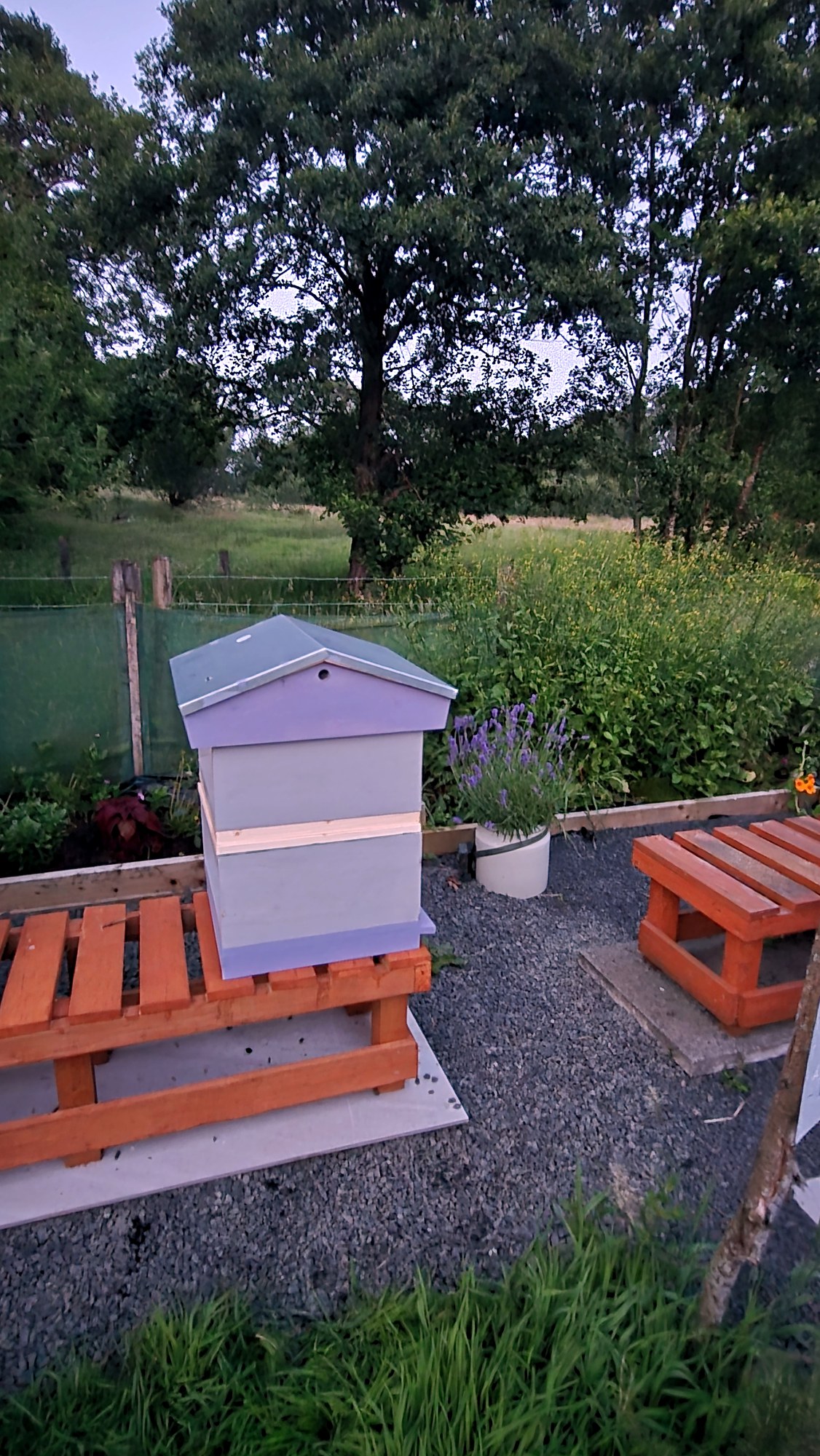
July is the month when the garden really starts earning its place for your bees. The June gap is behind you. The summer flow is on. And if you have lavender and borage anywhere near the hive, you will see more bee activity on those two plants than on almost anything else you have grown.
Plant One: Lavender
Ask Professor Francis Ratnieks, one of the leading honey bee scientists in the UK, what single plant a gardener should grow for honey bees and he answers without hesitation: lavender. Not because it is the highest nectar producer in absolute terms, but because it flowers right through the gap and into high summer, reliably, year after year, in conditions where many other plants struggle.
We bought English lavender, Lavandula angustifolia, and that is the one to go for. Hardy enough for Northern Ireland winters, long-flowering through June, July and August, and the variety honey bees work most readily. Honey bee tongues are slightly shorter than bumblebee tongues, which means they have to push their heads a little deeper into tubular lavender flowers to reach the nectar. Research from the University of Sussex found that a bumblebee takes about 1.1 seconds to extract nectar from a lavender flower. A honey bee takes about 3.5 seconds. It requires more effort. But they do it anyway, and in numbers, because the nectar reward is worth it.
For variety, English lavender cultivars Hidcote and Munstead are both compact, reliably hardy, and excellent for bees. If you want a longer flowering season, plant one early-flowering and one later-flowering variety together. You can extend the lavender window into September that way.
A Common Mistake About Lavender and Varroa
When we were researching this post we came across a claim on several gardening websites that lavender essential oil helps bees manage varroa mites, and that growing lavender near the hive might therefore be doing something useful for mite control.
It is a lovely idea. It is not really supported by the evidence.
Laboratory research has shown that concentrated lavender essential oil at high doses can affect varroa mites under controlled conditions. But the distance between that finding and growing lavender plants near your hive is very large, and the evidence does not bridge it.
Lavender near your hive feeds your bees. It does not treat your mites. Those are two completely different jobs and they need two completely different approaches.
The varroa treatment story is actually much more interesting than the internet makes it sound, and it starts with a question we found ourselves asking: what is the active ingredient in thymol-based treatments, where does it actually come from, and could you theoretically make your own from thyme plants? We are saving that for an autumn post when treatment season is relevant. The short answer is more surprising than you might expect.
A Note on French Lavender
You will see French lavender, Lavandula stoechas, everywhere in garden centres in summer. It is beautiful, with distinctive rabbit-ear bracts on top of each flower head, and it flowers earlier than English lavender.
But it is significantly less hardy than English lavender and will not reliably survive a Northern Ireland winter outside. And the nectar yield per flower is lower. For a permanent planting near the apiary, English lavender is the better choice every time. Buy French lavender for a sheltered pot if you love the look of it. For serious bee forage, plant English.
Plant Two: Borage
Borage might be the most remarkable plant on this entire list. It is an annual, so it dies each year. It is also virtually indestructible, because once you have it in your garden it self-seeds so prolifically that you will essentially have it forever whether you plant it again or not.
The flowers are small, star-shaped, brilliant blue, and they produce nectar continuously throughout the day. Research from Sussex University found that when honey bees and bumblebees had access to both lavender and borage at the same time, the honey bees strongly preferred borage. Ten times more honey bees went to the borage than to the lavender. If you want to know which of these two plants your honey bees will go for specifically, the answer is almost certainly borage.
It is also extremely easy to grow. Direct sow it in May or June where you want it to flower, water it in, and leave it alone. It will reach a metre tall, flop about attractively, and be absolutely covered in bees from July onwards. When it sets seed at the end of the season, let some fall where they are. Next year it will come back without you doing anything at all.
We have borage seed from Galgorm. It is going in the fruit garden near the fence this year. We are fully expecting it to gradually spread of its own accord over the next few seasons and we are completely fine with that. Nature doing exactly what nature does.
The July Imposter: French Lavender
We have covered this above but it is worth being explicit since garden centres are full of it in summer. French lavender is the one with the distinctive rabbit-ear bracts. It looks spectacular, flowers earlier than English lavender, and bees will visit it.
But it will not reliably survive a Northern Ireland winter outside, and the nectar yield is lower than English lavender. For a permanent planting near the hive, it is the wrong choice. English lavender every time.
THE GOOD: Borage. Sow it once near a fence and nature does the rest. Honey bees prefer it to lavender when given the choice. It asks almost nothing of you and gives your bees a lot. Possibly the best value plant in this entire series.
THE BAD: French lavender. Gorgeous, earlier-flowering, and not hardy enough to reliably survive our winters. Plant English lavender instead and it will still be flowering for your bees in twenty years.
THE STICKY: There is a jar of lavender honey somewhere in France right now that costs more than most people spend on a week of groceries. If you have ever tasted it you will understand immediately why the bees bother pushing their heads all the way into those flowers.
This post is part of The Bee Garden series, where we look at what to plant for honey bees in Northern Ireland, month by month through the year. Next up: August, and Northern Ireland’s liquid gold.
Mum & Bee Girl x