
Last time I told you the Apiguard was in a box waiting for the postman and that there was still time to do a proper count first. So we did the count. Four mites per 10cm square. For about ten minutes I let myself feel relieved. Then I did the sum properly and the relief did not survive.
What the board actually said
Here is the bit I nearly got wrong, in the ordinary beginner way.
The colony is clustered onto six or seven frames just now, drawing in for autumn the way they do. There is no cluster sitting over the rest of the floor, which means there is no reason for mites to be falling there either. No bees above a patch of board, no drop onto that patch, simple as that.
If I had counted one square and multiplied it out across the whole floor, or counted the whole floor including all that empty untouched ground, I would have ended up with a nice diluted number that told me almost nothing. So I did not do either of those things. I counted the actual area the bees are sitting over, all of it, not a sample square guessed at and scaled up.
Four per 10cm square, over five days, across the whole of that occupied footprint.
That is not the reassuring number four sounds like when you say it on its own. Once you count it properly, across the ground the bees are actually using rather than the ground the box happens to provide, it puts the real daily drop somewhere close to the figure the books call the treat now line for this time of year. Not a wildly high number. Not the low, everything is fine number I wanted it to be either.
The board was not wrong. I had just nearly read it the way a first year beekeeper reads a board, by doing the sum on the size of the box instead of the size of the cluster.
What the bees said
And then there was the other thing, which I had already half noticed and filed away without joining the dots properly.
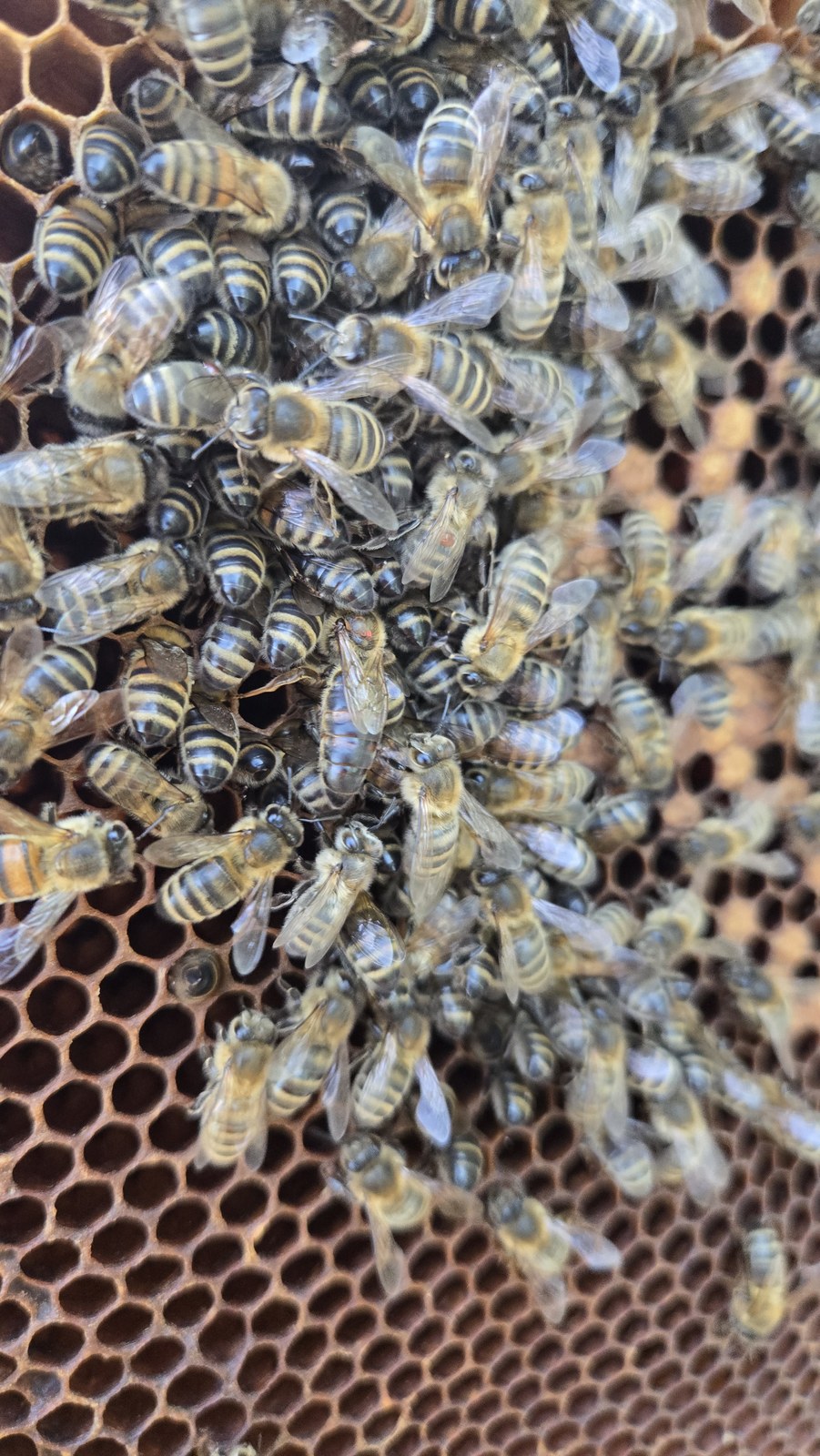
Back in Two Weeks Later I mentioned spotting a few varroa on the bees themselves. This inspection, lifting frames to see how the winter bees were coming on, there they were again. Not one. Several. Sitting on the backs of workers, plain as anything, on bees that were just walking about on the comb minding their own business.
A mite you can see sitting up on a bee’s thorax is not the normal, well hidden kind. Those tuck in underneath, between the plates of the abdomen, where a beginner with a phone camera will never spot them. The visible ones are the overflow. And most of the mites in a colony at this time of year are not on adult bees at all. They are sealed inside brood cells with the developing winter bees, which is exactly where you do not want them.
So once I had counted the board properly, it stopped disagreeing with what I was seeing on the bees. It started confirming it. Two different measurements, read correctly, landing in the same place.
Where I nearly went wrong
I am putting this bit in on purpose, because I think it is more useful to you than the tidy version.
My first instinct on seeing four was relief. Four sounded small. I very nearly wrote this whole post as a nice reassuring “we did a count and it turns out we were worrying over nothing” piece, right up until I sat down and actually worked out what four per square means when you account for how much square footage the bees are covering rather than how much the box provides.
That gap, between the number that sounds comforting and the number that is actually true once you do the sum against the right area, is exactly the kind of mistake a first or second year beekeeper makes without ever realising they have made it.
So the Apiguard went on
Last Tuesday, the trays went in. We had already decided on Apiguard and written a whole post about why, so I am not going to repeat that. What I will tell you is what actually putting it on was like, because the box makes it sound simple and mostly it is, but there was one instruction that changed something we had been doing all season.
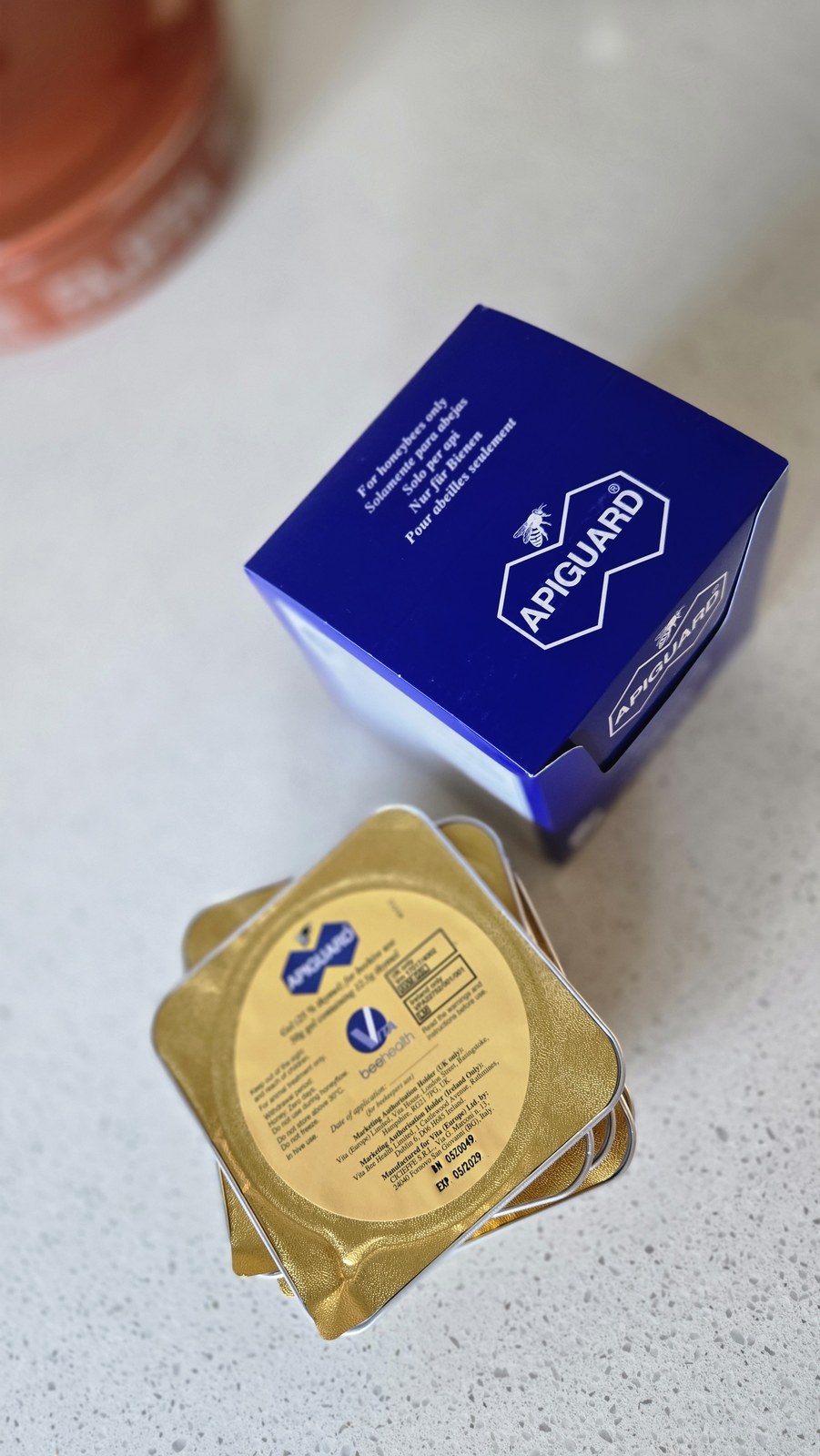
Each tray is 50g of gel, 25 percent thymol. You peel the foil back, leave it attached as a sort of lid folded under, and set the tray gel side up on the top bars, roughly over the middle of the brood. You need space above it so the bees can get at it, which means an eke or an empty super over the brood box before the crown board goes back on. Our eke went on and the tray sat in the gap looking faintly like something that fell out of a picnic.
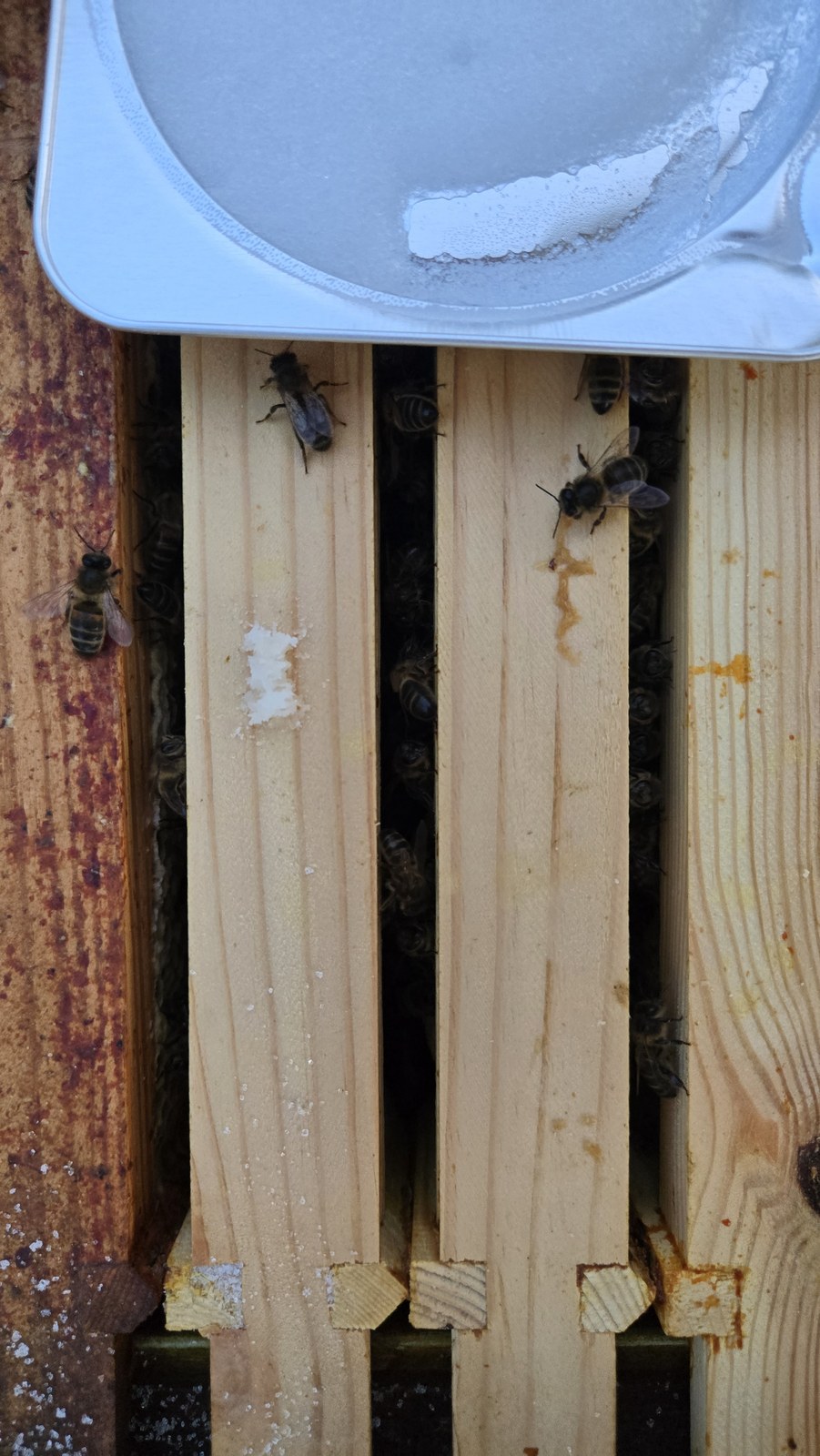
The box is very clear about a few things, and since this is a licensed veterinary medicine I did actually read them:
Good ventilation. This is the one that caught me out. Thymol works by evaporating, and the instructions are clear that the site needs proper airflow to release it properly. Our monitoring board, the one that gave us the count in the first place, sits under the open mesh floor and effectively blocks some of that airflow even with mesh above it. So it came out. No board under the hive for the length of this treatment. I will admit to a small pang taking it out, because that board has become the thing I check like other people check their phone, but the whole point of doing this properly is doing what the licence actually says rather than what makes me feel better.
Gloves on. Thymol is an irritant and the bit about washing your hands is not decoration.
Not during a honey flow. No argument there. We took no honey at all this year. The split went so badly that every colony we had spent the summer rebuilding itself rather than filling supers, and a jar of our own honey is now firmly a Year Three ambition, which given how this blog goes probably means it happens in Year Two of something else.
Not if the maximum daily temperature is going to be under 15 degrees. Late August in Antrim just about scrapes that, which is one of the reasons we went now rather than in a fortnight.
Treat every colony in the apiary at the same time. So both hives got a tray, and the nuc got one too, small as it is.
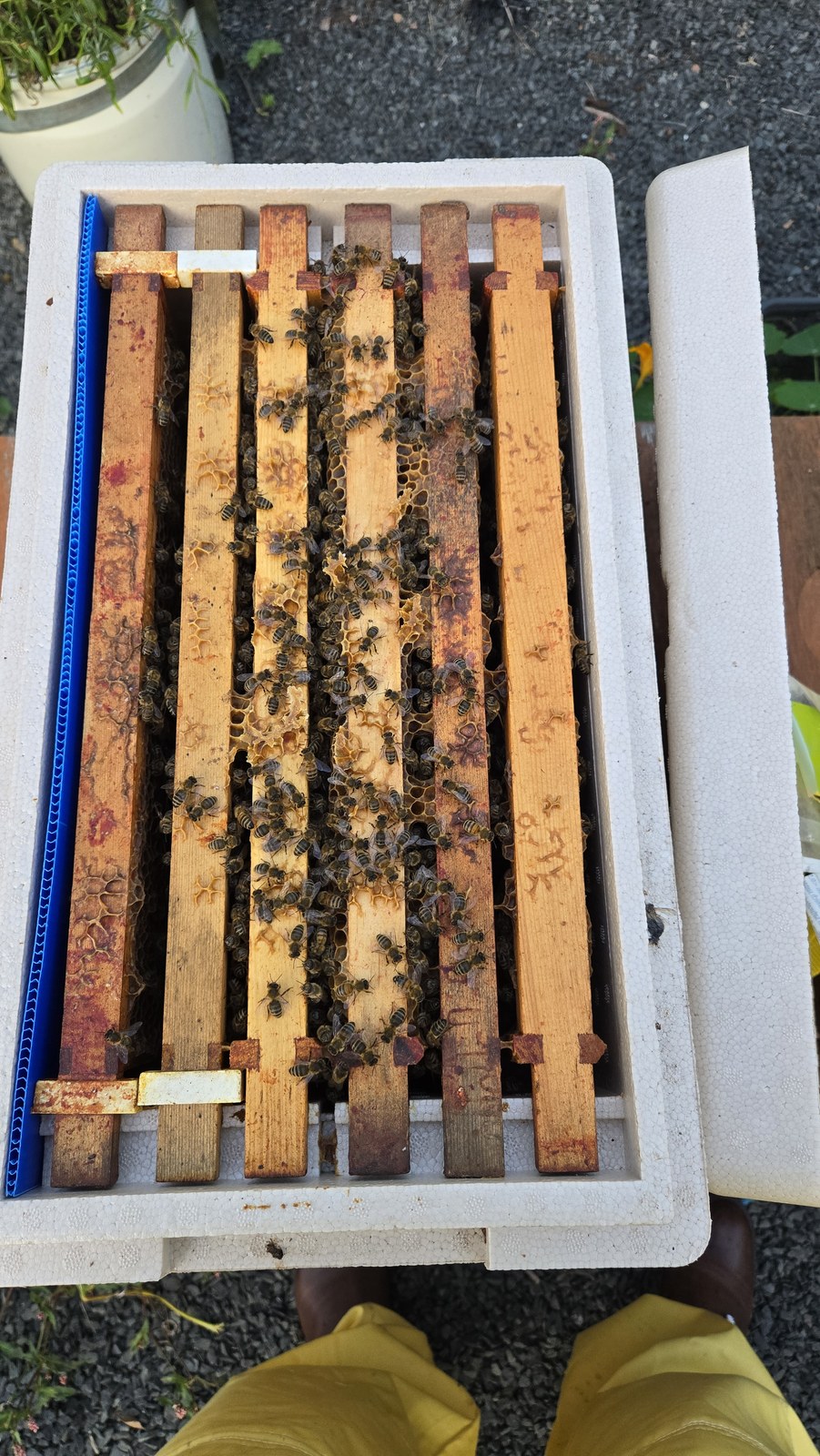
Combine weak colonies before treating. We have already done our combining this year, and the merged queen with her six frames of brood is the one colony I would not swap for anything.
One more line on the box stuck with me. It says bees may sometimes remove uncapped brood from around the tray, “especially with more hygienic strains,” and if you see that you should take the product out. I am not going to claim our bees are hygienic on the strength of a label warning, but for a mum who spends a lot of time reading about native bees and their habits, that is a sentence I will be watching for.
What we wrote in the record book
Treatments like this have to be recorded, and I have decided I would rather show you what that actually looks like than pretend it is something mysterious. Here is our entry, more or less.
Date applied: Tuesday 25 August 2026
Product: Apiguard, 50g tray, 25 percent thymol
Marketing authorisation: Vm 17017/4002 (UK)
Batch: 05Z0049, expiry 05/2029
Colonies treated: two hives and the nuc
Dose: one tray per colony, second tray due in two weeks
Withdrawal period for honey: zero days, but not applied during a flow
Monitoring board: removed for the duration of treatment, per product ventilation guidance
Notes: mite drop counted over occupied cluster area only, not full floor, before treatment began. Mites also seen on adult bees at inspection.
That last line is the honest bit. If a bee inspector ever reads our records I would rather they saw a beginner writing down what she actually thought, and how she actually counted, than a beginner writing down what looked tidy.
What happens next
The second tray goes on in two weeks. The monitoring board stays out until the full course is finished, because that is what the instructions actually ask for, and I have decided this is not the season to quietly ignore an instruction because I liked having the data more than I liked following the label.
Once both trays are done, the board goes back in and I will count the drop again, properly, over the actual cluster footprint rather than the whole floor, the same way I should have been doing it all along. A working treatment should show up as a real difference against that first count.
The nuc also needs to come up out of its box and into a full brood box before the weather turns, so that is on the list for the next warm day, tray and all.
Then in the broodless window in winter, oxalic acid, which is the follow up this treatment needs to actually finish the job. But that is a December post.
The Good, The Bad, and The Sticky
The Good: the treatment is on, every colony got it on the same day, and I caught my own mistake before it made it into print as good news that was not actually good news.
The Bad: I saw mites on the bees in August, on the colony I have been building up all summer, and once I did the count properly the board agreed with what my eyes had already told me.
The Sticky: I had to take the monitoring board out and fly a bit blind for the next few weeks, trusting the process rather than checking on it daily, which if you know me at all is not a sentence I write lightly.
Mum & Bee Girl x