
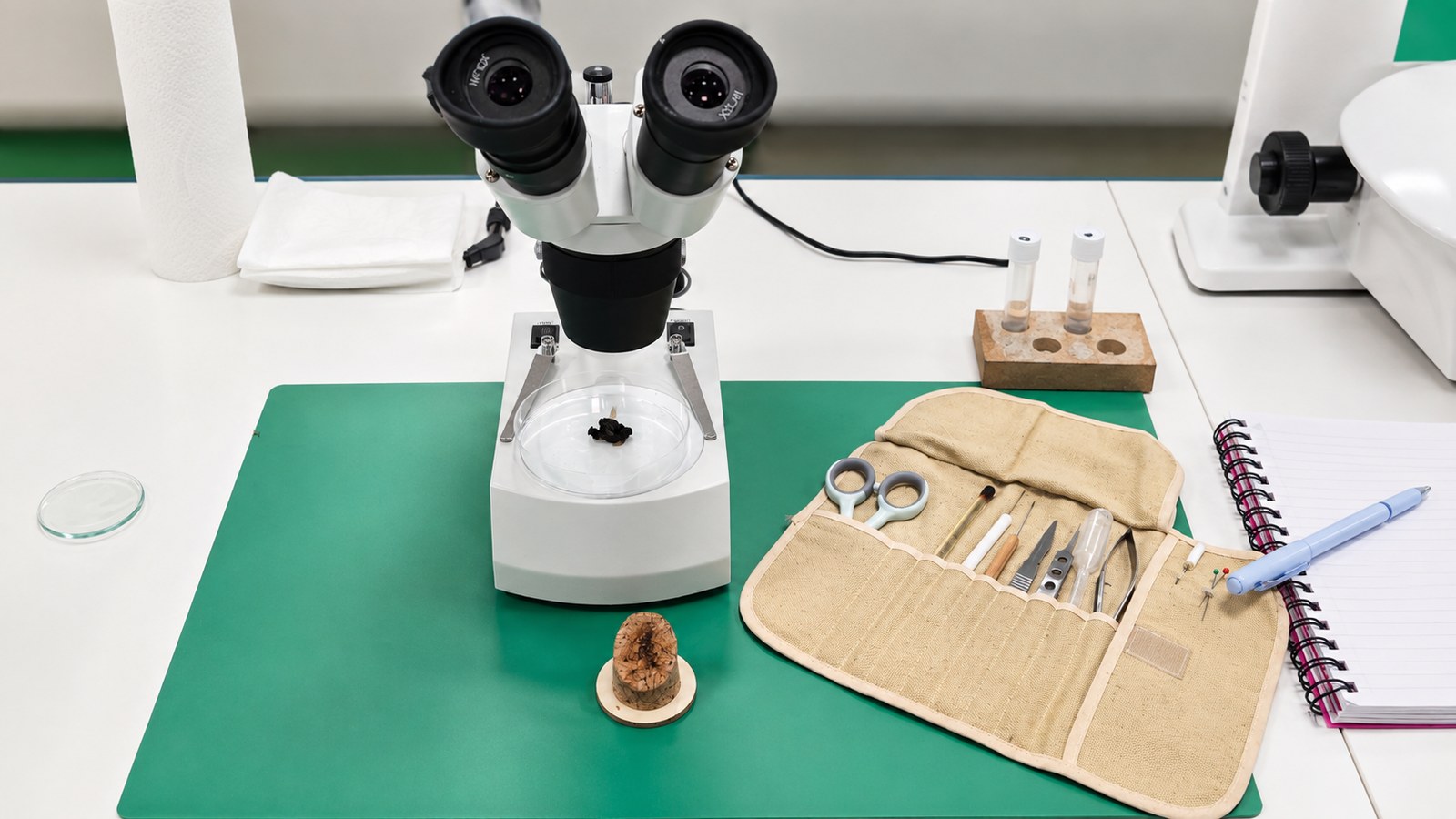
We have spent two years watching bees fly home loaded with pollen and never once properly looked at what any of it actually is. Saturday put that right. No suits, no smoke, just a bench, two microscopes, and the two of us finding out there is a whole other side to beekeeping that happens after the bees have already done the work.
The morning was spent taking a bee apart under the stereo microscope, the low powered one that gives you a proper 3D view so you can actually work on a specimen with tools while you watch it happen. Wings, legs, antennae, off with fine tweezers, under bleach, under acid, flattened and mounted under glass. We managed to lose one wing to a stray breath and are not naming names. What stuck with us both was the moment we found the hamuli, the tiny row of hooks that zip a bee’s forewing and hindwing into one in flight. We had both read about them for years. Neither of us had ever actually seen them until Saturday, and we said so out loud at exactly the same time, which tells you something about how we spend our weekends.
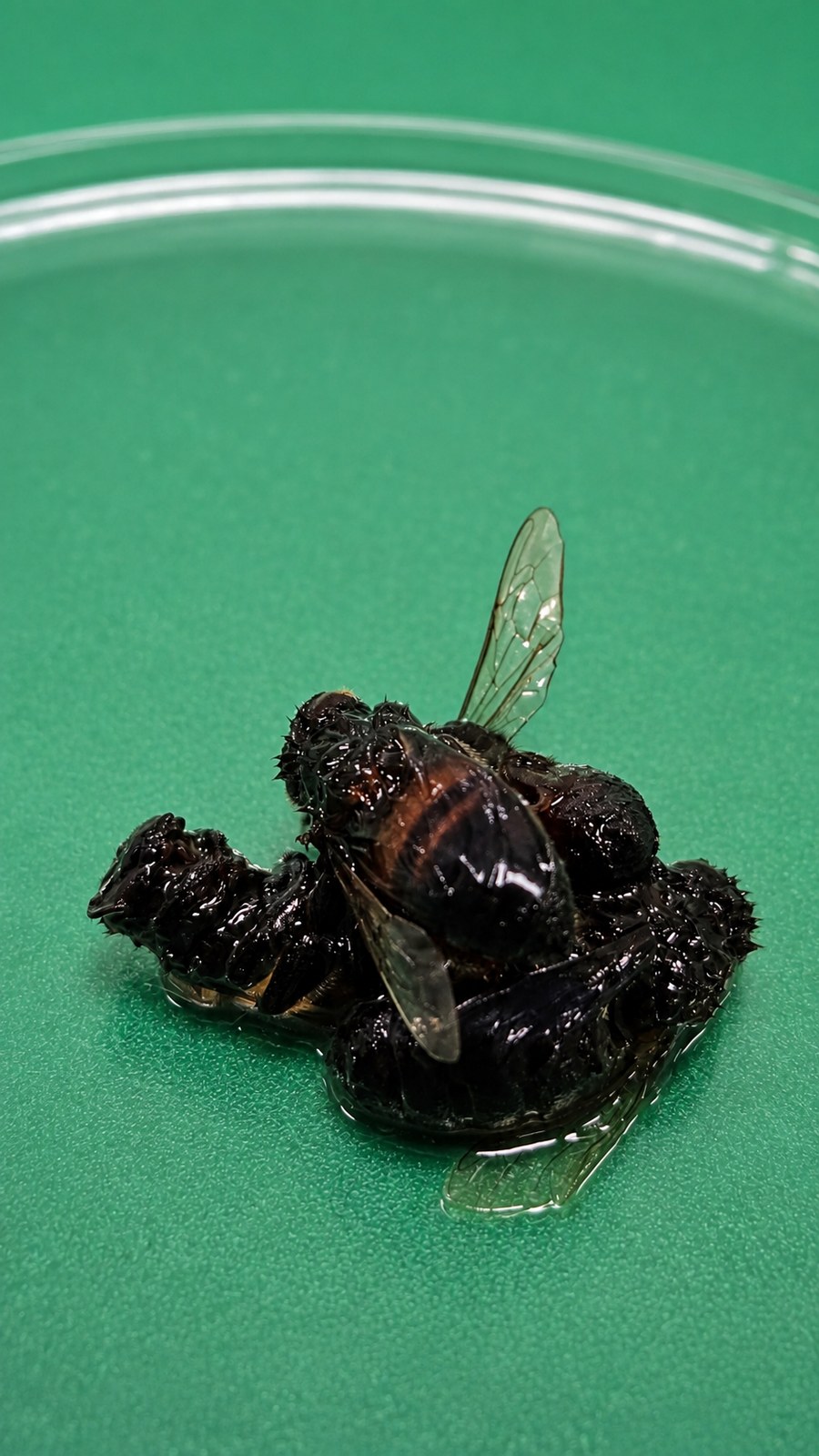
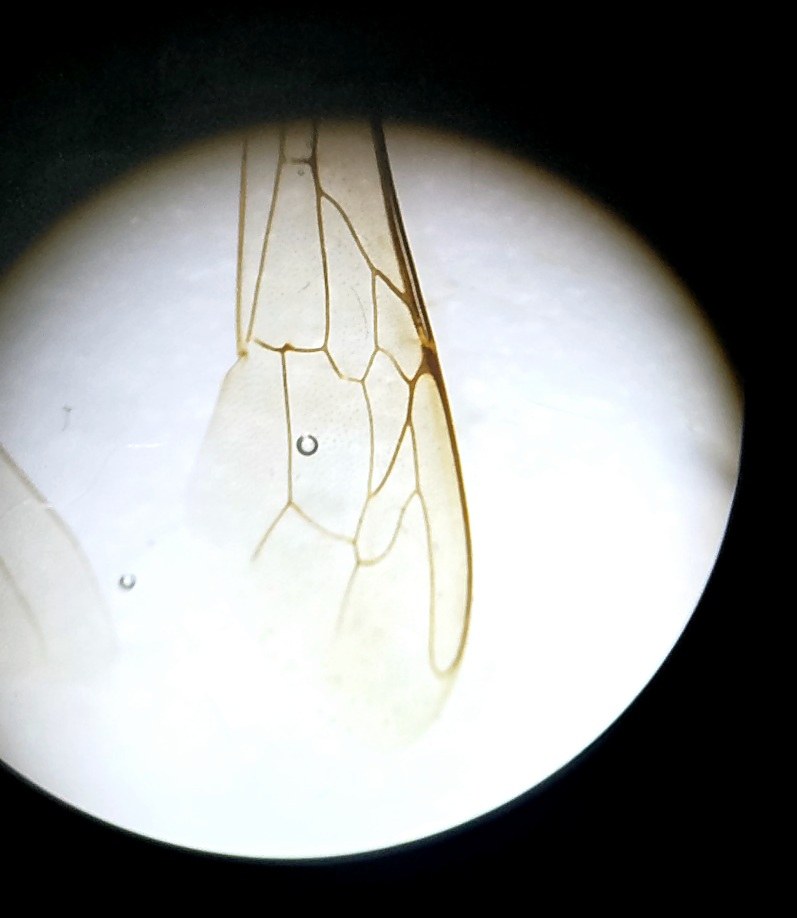
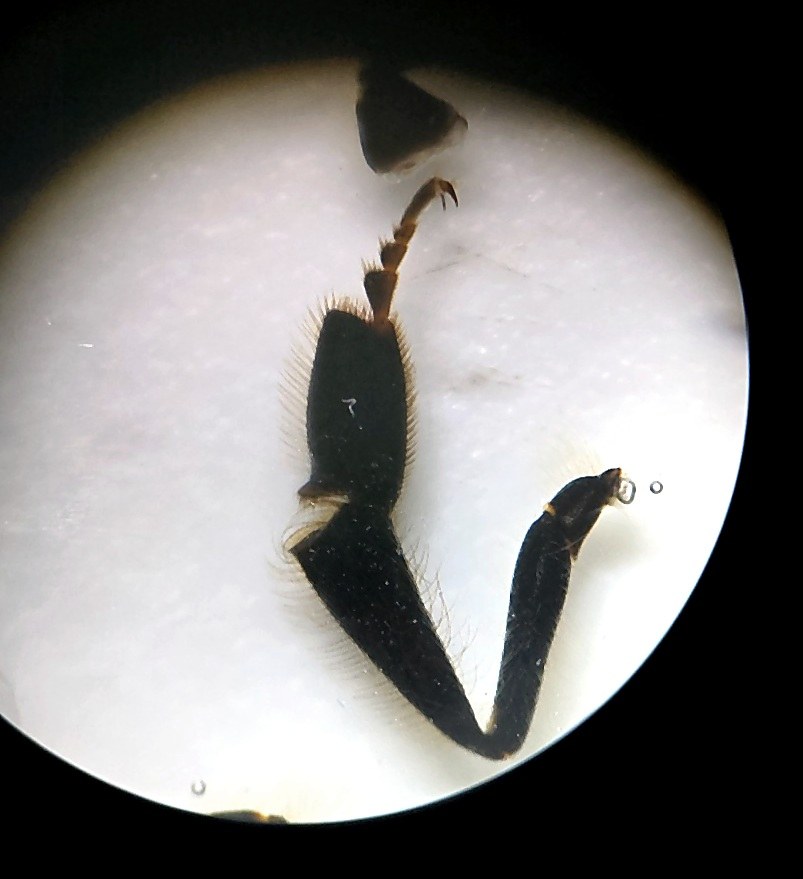
None of that was the point of the day, though. It was the run-up to the afternoon, and the afternoon was about pollen.
Why anyone does this at all
Here is the thing nobody tells you when you start keeping bees. A hive brings home pollen in every colour going, yellow, orange, deep red, grey, and you would assume all of that colour ends up somewhere in the honey too. It does not. Honey is made from nectar, not pollen, and it is the nectar, its sugars, its minerals, its own plant chemistry, that actually gives honey its colour and its flavour. The pollen is in there too, but only ever as a trace, measured in thousands of grains per gram rather than anything you would ever see with your own eyes.
That trace is not an accident and it is not useless. It is a fingerprint. Whatever pollen turns up in a jar of honey tells you, with real precision, which flowers the bees were actually working when they made it. That is exactly what we spent the afternoon learning to read.
We started with something known. A pinch of hazel pollen, mixed with alcohol, dried onto a slide, a scrap of stained jelly melted under the coverslip, and there it was under the compound microscope, wee pink dots you could measure and describe properly. Ours came out at 25 microns, roundish, three pores. The idea is that you build up a personal library this way, one known flower at a time, so that when something unfamiliar turns up later, in a pollen load or in your own honey, you have something honest to check it against rather than a guess.
Then the instructor handed us real pollen loads from his own bees and asked us to work backwards. Colour gets you started and then abandons you completely. It is the size, the shape, the pores and the surface pattern that actually get you an answer, checked against your own slides and against the reference book. Between us we worked through loads that turned out to be hawthorn, blackthorn, dandelion, rosebay willowherb, primrose and Himalayan balsam, and got a fair few of them wrong before we got them right. One of us was convinced a smear of green in one load was a whole new pollen type. It was rubbish. Debris happens.
Where this actually leads
This is not just a nice thing to know at a beekeeping club. What we were doing badly with a hazel catkin and a lot of squinting is, done properly, the same technique that professional labs use to verify what is genuinely in a jar of commercial honey, and to catch it when it is not what the label claims. Honey fraud is a real and ongoing problem worldwide, and pollen analysis is one of the main tools used to catch it, because you cannot easily fake a pollen profile.
For us, closer to home, it means something simpler but no less important. It means that one day we will be able to look at our own honey and say, with actual evidence rather than a hopeful guess, what our bees were really working that season. Given how much time we spend fretting over forage, heather flow, whether the paddock is worth planting up, this feels like the missing piece. We have been guessing what is in our jars for two years. We are finally learning how to know.
What we brought home
Two sets of slides, wings, legs and antennae between us, a hazel reference slide with more bubbles in it than either of us would like to admit, and an ongoing and entirely unresolved argument over whose slides came out best. The instructor kept saying it, first slides are practice, not trophies. Fine by us. We are well used to that lesson, in beekeeping and in most other things.
The course itself could not have been better run. Patient, properly hands-on, and clearly taught by someone who has spent a long time thinking about how to get complete beginners to a real result by lunchtime. Not competent enough to go off and do this unsupervised, not yet, but a genuine, usable slide in your hand by the end of the day. There is a follow-on day covering the more advanced disease work. Saving that one for another time. Plenty to practise at home first.
More from us: how bees smell without a nose, and what recapping behaviour tells us about varroa resistance.
Mum & Bee Girl x