
Right. Sit down. This one’s not a nice one.
I went out to check on the hive with the new queen in it. You’ll remember her, she’s the one we got in after the last queen went up on a mating flight and never came home. This new one was meant to be the fresh start, the “right, we’ve sorted that now” hive.
I opened her up and the wasps had cleaned her out.
If you’ve come here because wasps are attacking your beehive right now, skip down to the pipe. The rest of you, sit tight.
Not “a bit thin.” Cleaned out. There were maybe a few dozen bees left in the whole box. Not seams, not frames, a few dozen individual bees you could have counted on your fingers if you’d the patience, which I did not. And wandering through the middle of them, cool as you like, completely unbothered, was the queen. Still there. Still alive. Doing absolutely nothing useful whatsoever, as far as I could tell, other than existing.
So we haven’t lost her. Small mercies. But we haven’t got much of a colony left to give her either.
The thing I nearly did, and thank goodness I asked first
My first thought, standing there with my heart in my boots, was to shut the front door. Seal them in for three days, let the wasps get fed up and go elsewhere, let them back out.
Glad I said this out loud before I did it, because it turns out that’s exactly the kind of thing that feels right and is actually a disaster. Three days shut in a warm poly box with a handful of bees and no ventilation would very likely have finished the job the wasps started. Heat, damp, stress, no fresh air. And here’s the thing, the wasps don’t get bored. They just wait outside like they’ve nothing better to do, because they haven’t. Open the door on day four and there they still are.
What actually works is far less dramatic than a three day lockdown. You shrink the entrance down to about the width of one bee, roughly a centimetre, so the handful of bees you’ve got left can actually stand there and defend it.
Or, better again, you make it a tunnel.
Enter: a wasp proof tunnel entrance, made from blue water pipe and a fistful of grass
We had some blue MDPE pipe knocking about, the sort used for mains water. Cut about six inches off it, pushed it into the entrance, packed grass in round the sides so the pipe was the only way in or out.
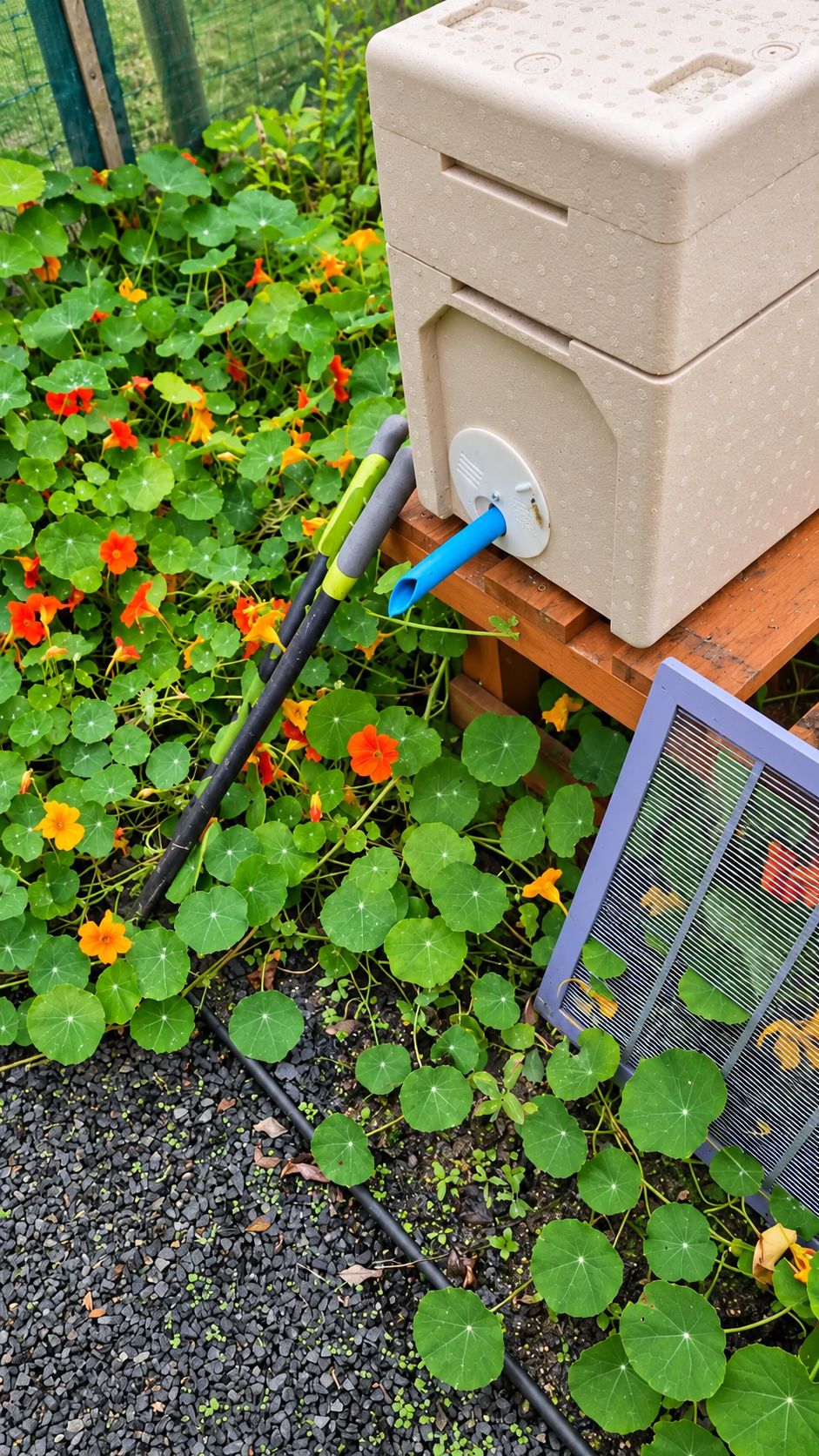
Bees work out a tunnel in about a day. Wasps hate them. They won’t commit to a dark hole they can’t see the end of, and the ones that do arrive one at a time into a space where the guards are waiting for them. Front door becomes a corridor with a bouncer on it.
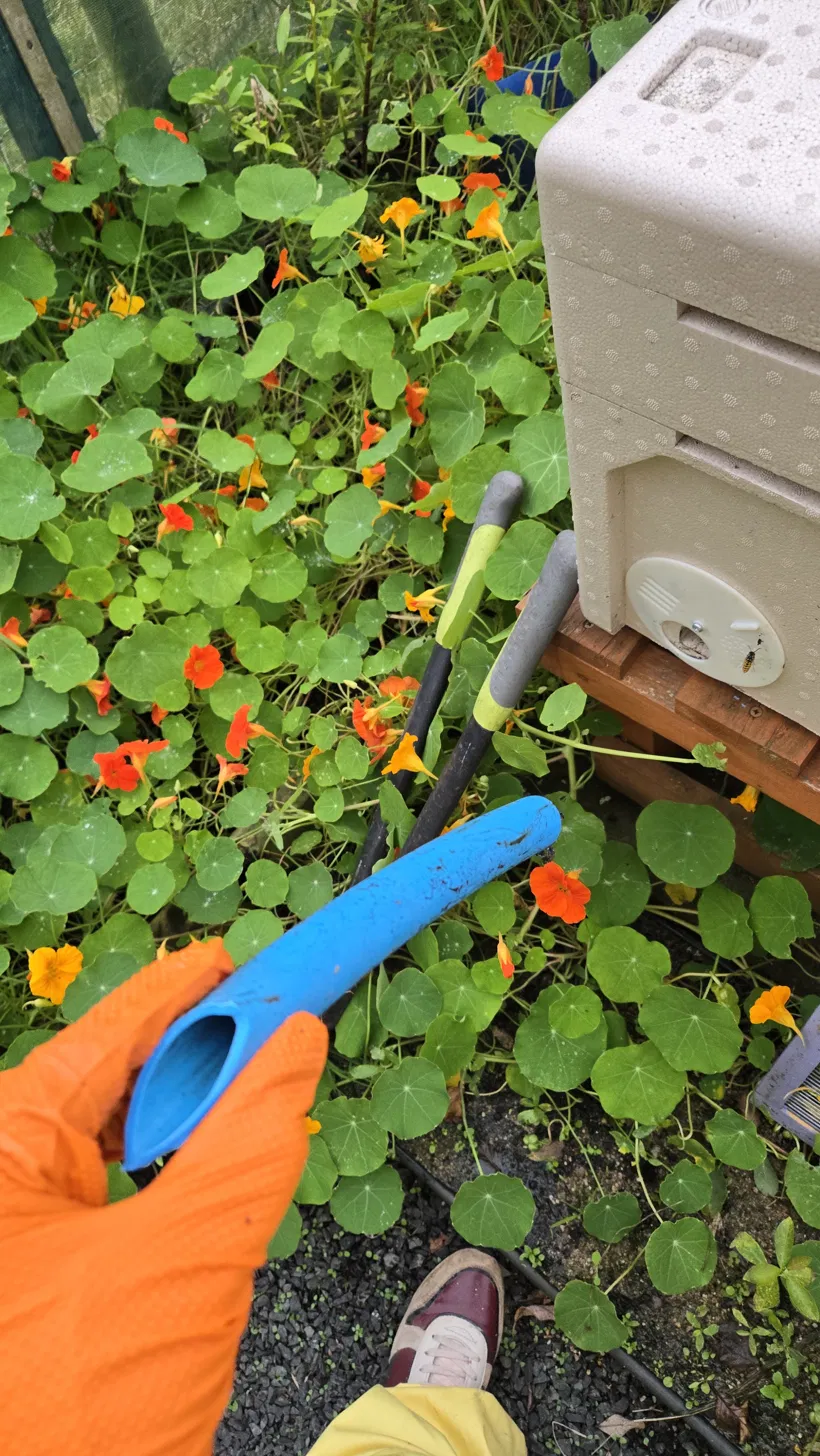
I’ve a photo of the entrance from just before the pipe went in, the pipe still sitting in my gloved hand, not yet anywhere near the hole, and there’s a wasp already on the disc, having a good look round the bare entrance while I stood there deciding where to start. That’s really the whole argument for the tunnel in one picture, they’ll try the front door the second it’s open and unguarded.
Pipe went in after that, packed round with grass so it was the only way through, and it went in level rather than pointing down, because a tunnel that’s open to the sky at an angle is really just a funnel with extra steps. Dark and enclosed all the way along is the whole point of it.
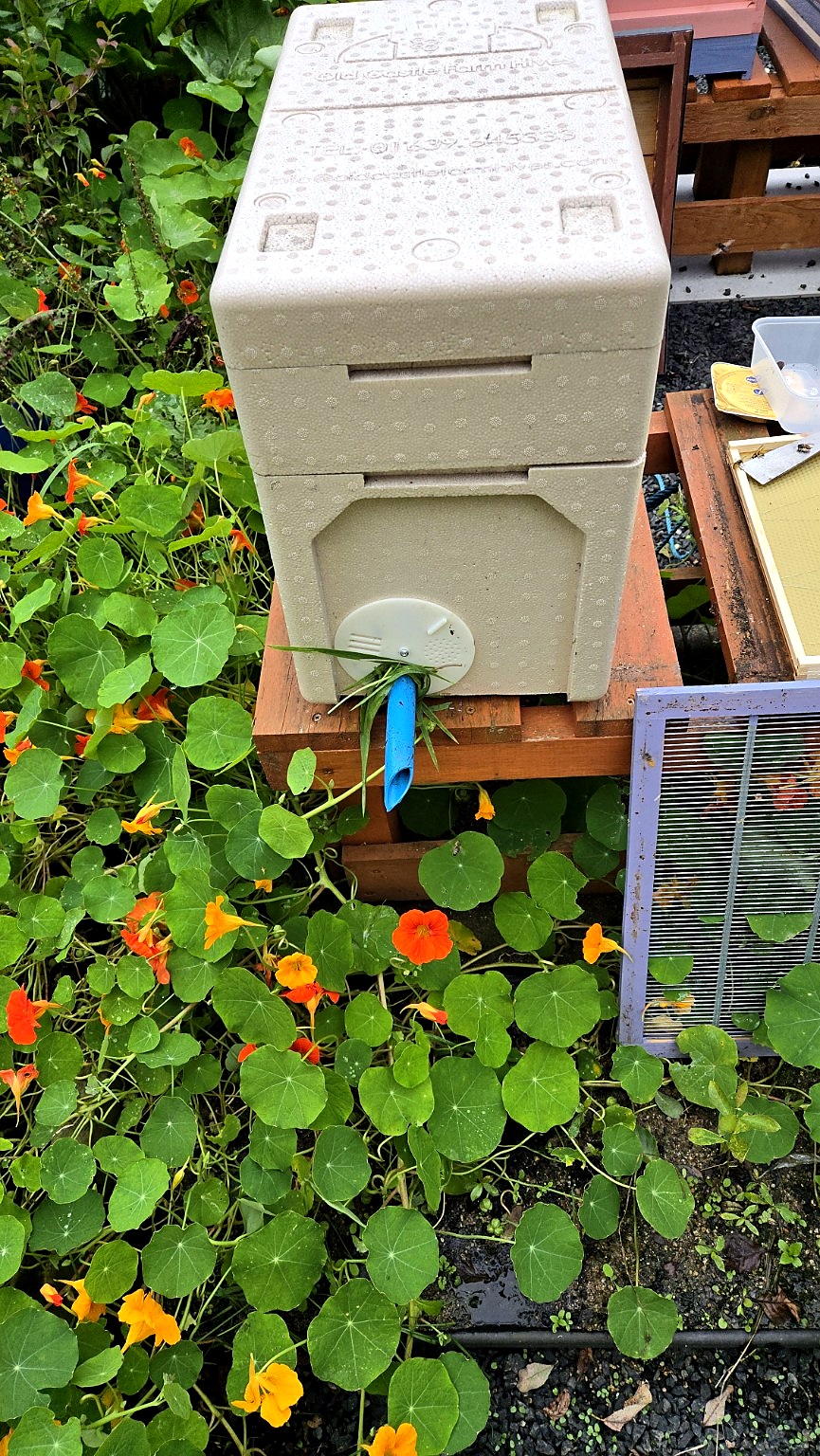
One thing worth knowing if you’re trying this yourself. A long tunnel blocks up with dead bees fairly fast, and a colony this small has almost no undertakers spare to shift them. Check it daily. If the traffic stops, give it a poke.
Now the bit I’d genuinely rather not write
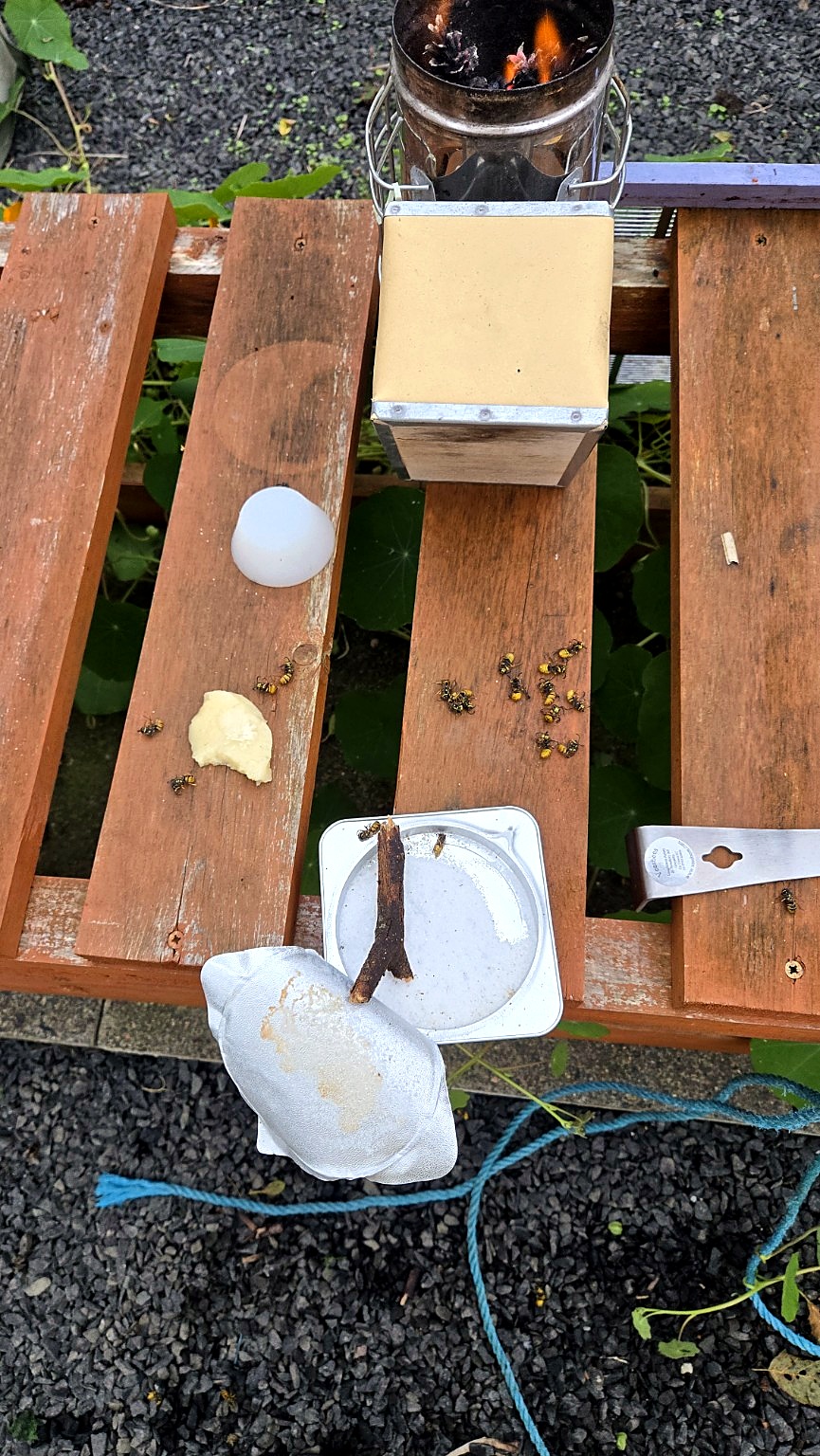
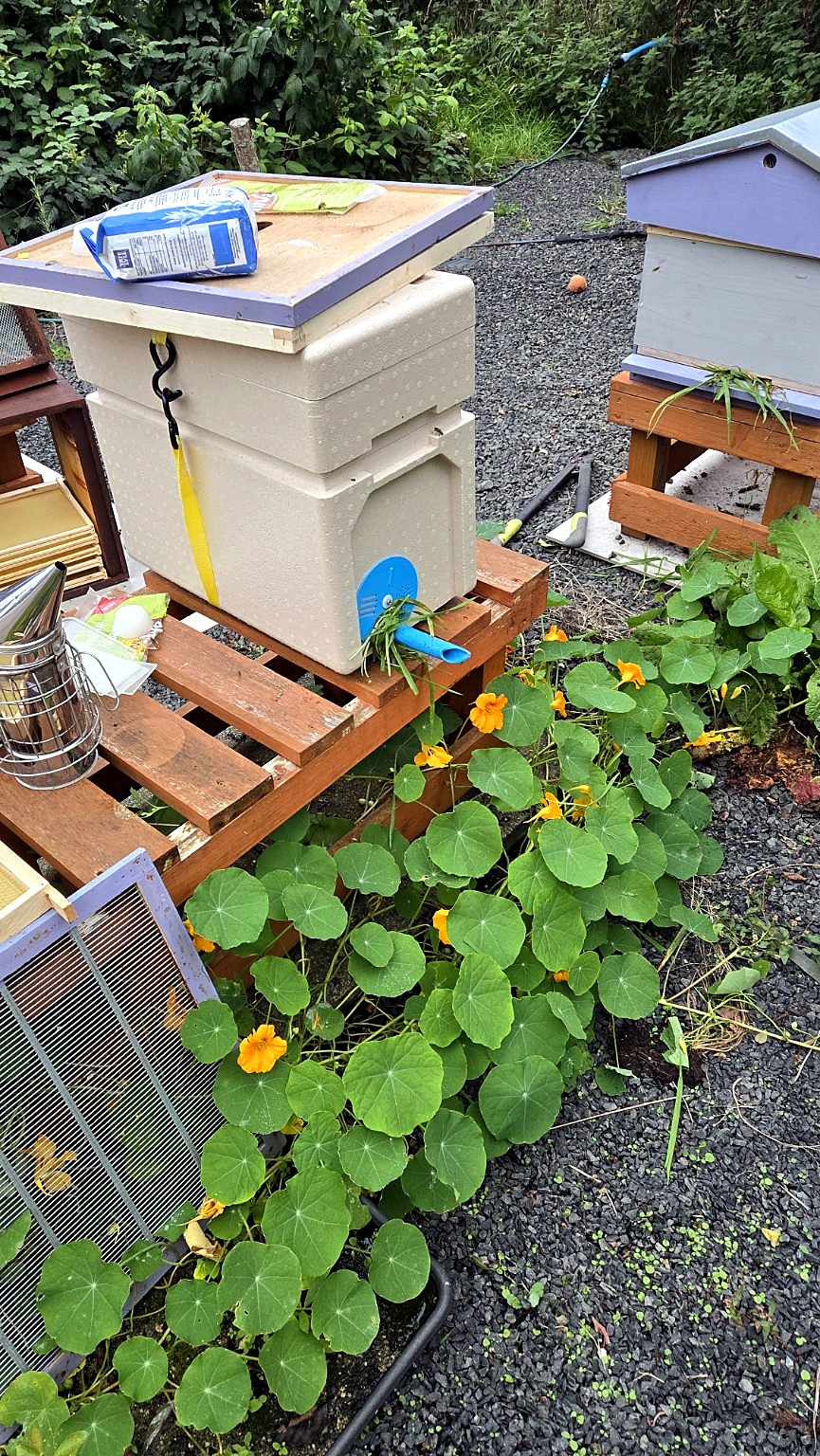
While I was standing there feeling rather clever about my pipe, I took a photo of the pallet next to the hives.
There, in plain view, was a lump of fondant sitting wide open on the wood. The empty wrapper beside it. A used Apiguard tray. And about twenty wasps merrily helping themselves to the lot, two feet from three struggling colonies.
I had, without meaning to, built them a buffet. And then genuinely wondered why they wouldn’t clear off.
That’s not really a wasp problem. It’s a me problem, but not the one I first made it out to be. I was in the middle of moving the hive into the nuc when I took that photo, hands full, half my attention on the bees and half on not getting stung, and the fondant and the tray had just been set down beside me while I worked rather than left lying about the apiary for days. But it doesn’t take days. It took about the length of time it takes to get a hive shifted. Any open sugar sitting out in September, even for the ten minutes it takes to do the actual job, is a flare going up saying come and get it, bring your friends. It draws wasps in fast, teaches them exactly where the good stuff is, and once they’ve had what’s on offer they start looking for more at the nearest front door, which happens to have bees living behind it. The smell hangs about for a good while after you’ve cleared it away too, so you’re scrubbing the pallet, not just lifting the food.
If a colony needs fondant, it goes inside the hive. Over the hole in the crownboard, under the roof, somewhere only the bees can get to it, and whatever’s left over goes straight back in a bag rather than sitting on the bench while you get on with the next job. I knew that. I just had both hands full of hive at the time and the supplies were the last thing on my mind until I looked down and found I’d an audience.
Clearing that mess away probably did more good in one evening than anything else I managed out there.
The maths I really didn’t want to do
Here’s the thing about why that colony emptied out so fast, and it isn’t entirely down to the wasps.
We’d bought her in, and the plan was to leave her well alone to settle while we got the Apiguard done, rather than going in and disturbing her before she’d found her feet. Sensible enough on paper. But thymol has a well earned reputation for putting queens off laying, especially young ones who haven’t properly settled yet, so giving her that quiet fortnight may have meant giving her a fortnight of not laying as well. There’s a genuine chance she simply hasn’t laid an egg at all. That’s a real explanation, not wishful thinking on my part.
But it also means no new bees have come through in that hive for a while. Summer bees only live about six weeks. So the workers who were in there were quietly running out the clock with nothing behind them to take over. A colony can look fine one week and be down to nothing the next, and the wasps just finish off what was already failing before they ever arrived.
Then the calendar has its say too. Egg to emerging bee is twenty one days. Even if she started laying tomorrow, the earliest a new bee walks out of a cell is the first week of October. And the bees that actually carry a colony through winter, the plump long lived ones, are mostly reared from late August into September. Anything laid in October is emerging into a colony that’s already shutting down for winter, generally on poorer feeding, and those bees just don’t have the same staying power.
So the honest answer, and I did promise you honest, is that this colony is unlikely to see winter out on its own no matter what happens next.
I’m giving her a chance regardless. Tray’s coming out, she gets seven to ten days, and I’m going in looking for eggs around the nineteenth or twentieth of September. I’ve actually written that date down, because the temptation with a queen you want to succeed is to keep giving her just one more fortnight, and one more, until suddenly it’s November and there’s nothing left to decide.
Eggs by then and we’ve got something worth building on. Nothing by the end of September and the kind thing to do is unite her few bees behind whichever queen is actually laying, rather than nursing a lost cause through the cold.
Why this whole year has felt like this
Here’s the honest starting point, because it would be easy to blame this all on the weather and that wouldn’t be quite fair.
It goes back to June, to a swarm control split that was meant to be the one thing we’d finally got right. A proper textbook artificial swarm, executed carefully, the colony responding exactly as it should, or so we thought. Except the textbook forgot to mention that a colony which has already decided to swarm will swarm anyway, and we’d left the queen in the main hive rather than moving her into the nuc, which someone at the club pointed out about six weeks too late to be of any use. The bees swarmed regardless. One side went queenless long enough that the workers started laying, which is its own particular nightmare to untangle.
Everything since has been recovery, not building. Every colony spent the summer rebuilding its own population rather than filling supers, which is the plain reason there’s no jar of our own honey this year. A colony that spends June and July rebuilding from nothing doesn’t arrive into autumn strong. It arrives exactly where these three are sitting now, small, behind, and with nothing spare to absorb a bad run of wasps on top.
The queen who never came home from her mating flight in August wasn’t a separate stroke of bad luck landing on us out of nowhere. She was another link in the same chain, a colony still catching up from June that didn’t have the numbers or the margin to spare for a queen problem of its own.
So it wasn’t the mating weather that did for this season, not really. It was one split in June that went sideways, and everything since has been the knock on effect of trying to recover from it while the calendar kept moving toward winter regardless of whether we’d caught up.
I’d had a plan for queen rearing next year. That plan needed strong colonies, because a cell raiser has to be bursting with young bees and fed hard, and mating nucs need bees to fill them. You cannot rear queens out of three weak colonies without losing the three weak colonies in the process. So that plan’s pushed out, probably to the year after, and building numbers back up has to come first.
Two nucs are landing next weekend, which does help the mood. I’ll be checking their brood myself the moment they arrive rather than taking anyone’s word for it, and their entrances are going on tight from the second they touch down, because we already know exactly what’s flying about round here.
If you’re new to this: how to stop wasps attacking your hive
Shrink your entrances now. Not in October, now. September is when wasp nests are at their biggest and the workers have switched entirely to hunting sugar, because the queen inside has stopped laying and there’s no brood left at home to feed.
Never leave comb, fondant, or syrup sitting open in the apiary. Not even for ten minutes while you nip in for a cup of tea.
Feed inside the hive only, in the evening, and don’t spill a drop.
And if you’re looking at a colony wondering how it collapsed so quickly, count backwards rather than forwards. Ask yourself when the last brood actually emerged, not just what turned up and finished it off.
The Good, The Bad, and The Sticky
The Good. She’s alive. The tunnel works, the bees are getting through it fine, and the wasp traffic dropped away almost as soon as the food disappeared. Two nucs are on the way. And the drawn comb and the kit are all still here, which means there’s always a spring coming, whatever happens between now and then.
The Bad. Three small colonies, none of them where they should be sitting in September. A queen who may or may not have laid a single egg in her life so far. A season where the weather made most of the big decisions for us and didn’t ask our opinion once.
The Sticky. A lump of fondant, twenty wasps deep, sitting on a pallet not two feet from the hives, and me standing over it holding a bit of blue pipe, feeling terribly pleased with myself for about four minutes before I noticed.
Check back around the twentieth. We’ll know a lot more then than we do tonight.
Mum and Bee Girl x