
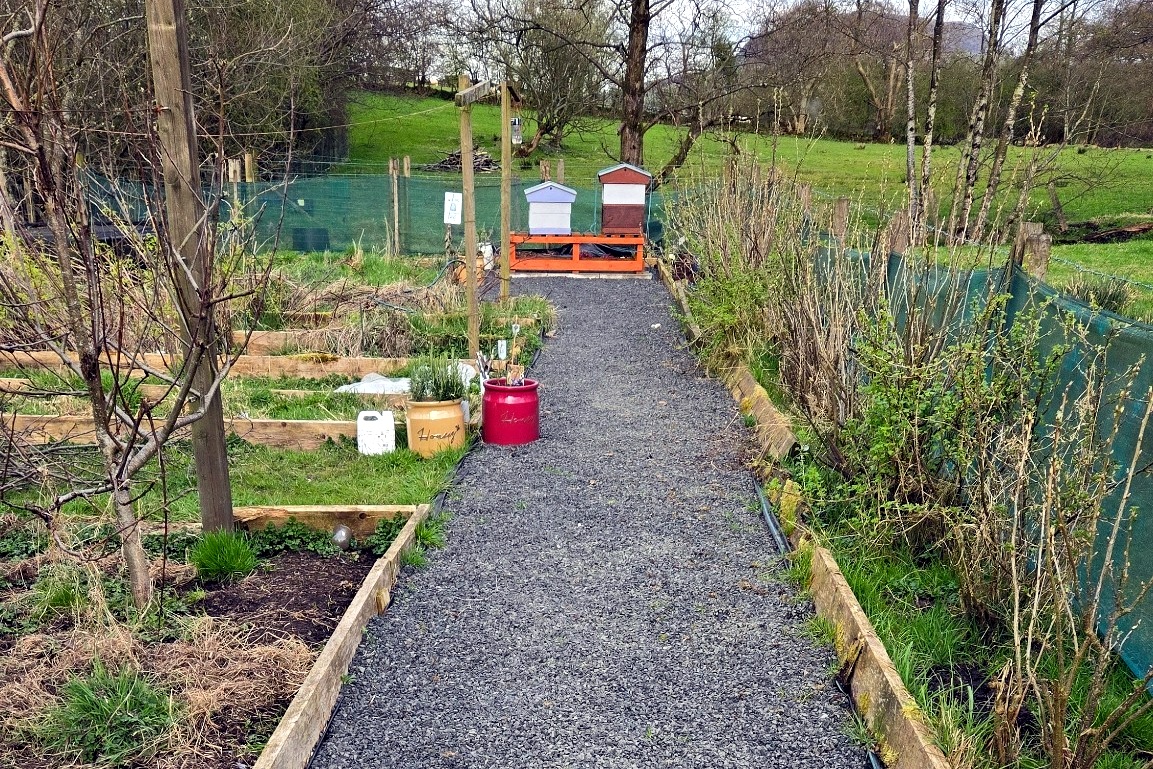
The home apiary. Three hives and a new nuc, as of this week.
We ordered the Apiguard yesterday. It hasn’t landed yet, and for once that’s useful, because it means there’s still time to do a proper mite count before anything goes near a hive.
Three hives now, and a new nuc that turned up a few weeks after we thought we were done with nucs for the year. That’s where the season has left us after a poor harvest, two merges, and mating nucs that failed twice before this one finally took.
Underneath all of that the mites have been getting on with their own summer.
So this post is about how we chose a varroa treatment for this round, and why Apiguard is the one sitting in a box waiting for the postman rather than something else. If you’re newer to this than we are, the reasoning is probably more useful than the product name.
Timing matters more than we realised
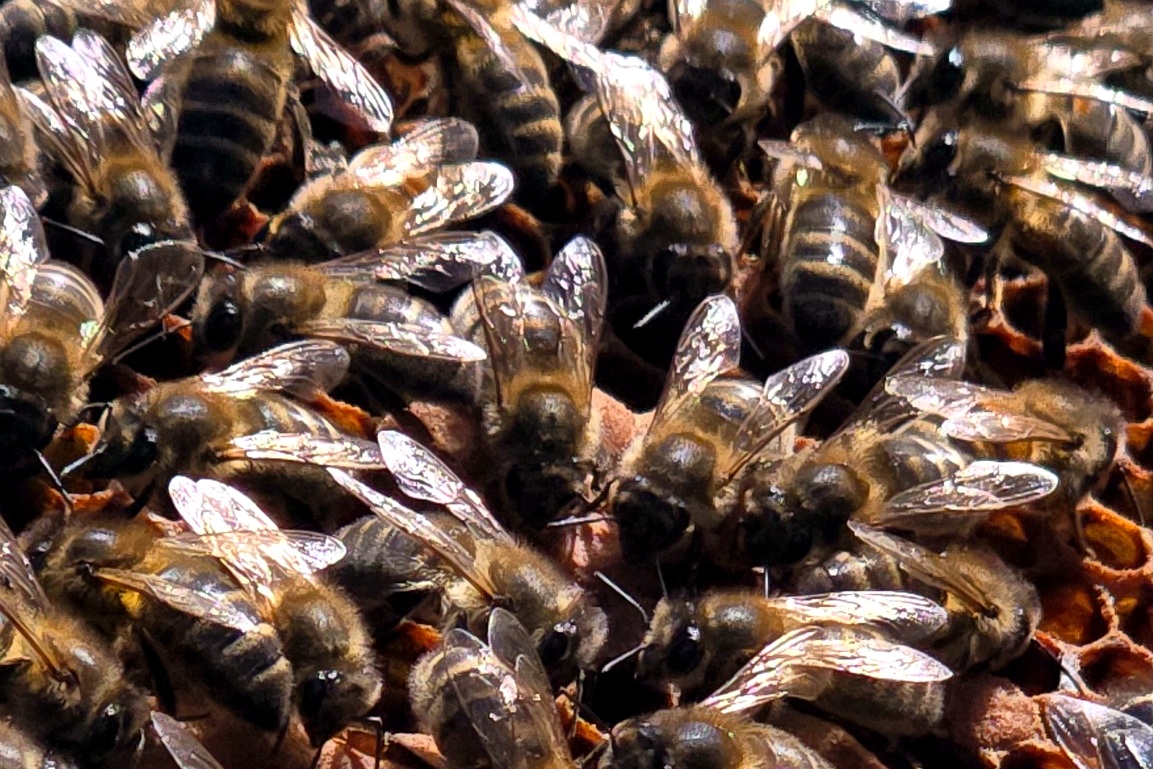
A full frame in August. Somewhere in here are the winter bees being reared right now.
A colony in August isn’t making summer bees any more. It’s making winter bees, the long lived ones with the fat bodies that have to carry the colony through to spring, and they’re being reared right now, in cells mites are feeding in.
A summer bee lives about six weeks, so if varroa takes something off her the colony barely notices. A winter bee has to live five or six months. If she’s reared in a cell with two mites on her, she’s not going to make it that far, and neither is the colony. That’s why colonies that look fine in October can be a handful of bees round a dead queen by February. What gets called a winter loss is very often an August varroa problem that nobody caught in time.
The National Bee Unit’s current Best Practice Guideline on varroa puts it plainly: treatment by late July matters because infestation can build fast through August, exactly when the winter bees are being raised. We’re a few weeks past that ideal window ourselves, which is part of why the count happens now rather than later.
Count first
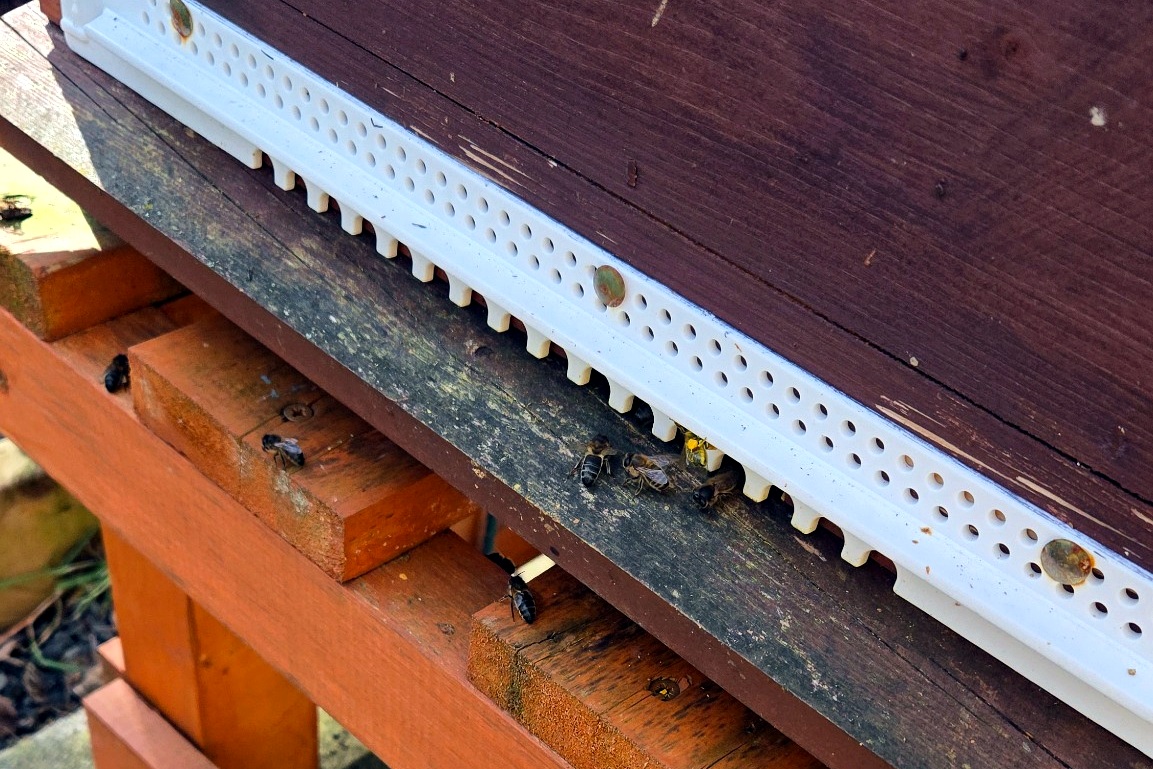
The mesh floor and entrance. Whatever falls through here lands on the inspection board underneath.
Before choosing anything, count. The NBU recommends monitoring at least four times a year, using natural mite drop, drone brood uncapping, or an alcohol wash or sugar roll. Their working figures are colony populations kept below roughly 1,000 mites, with around 2,500 meaning irreversible damage and a real risk of collapse.
We use the mesh floor and an inspection board, and uncap drone brood with a fork when there’s drone brood to uncap. Neither method is precise. Natural drop shifts with colony size, brood levels and the weather. Drone uncapping oversamples, because it’s checking the cells mites prefer most. An alcohol wash is the most accurate of the lot and the least popular, for the obvious reason that it costs 300 bees to find out.
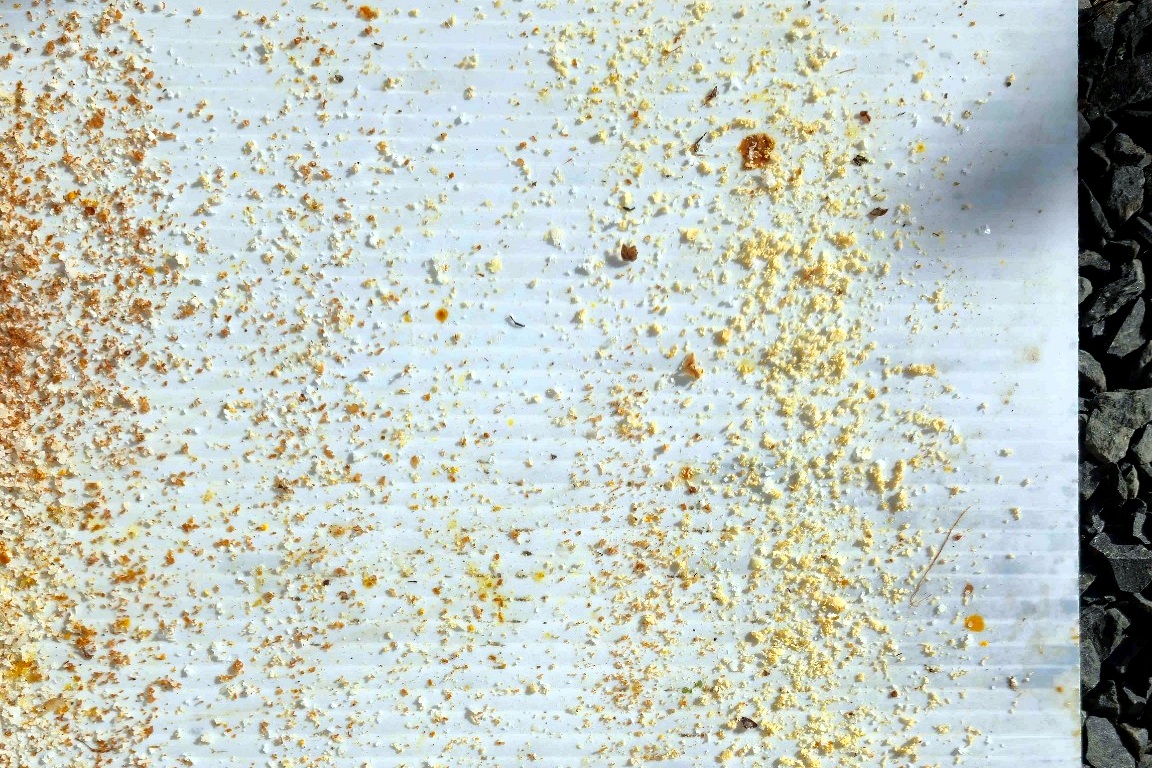
This week’s inspection board. Cappings, pollen, and whatever else came down, worth a proper look with a hand lens rather than a guess from across the garden.
The count isn’t about hitting an exact figure. It’s the only way to know in October whether whatever we did actually worked, which is the bit we skipped last year.
The menu
According to the National Bee Unit’s June 2025 medicines list, there are thirteen authorised varroa treatments in the UK, falling into three families.
Thymol and essential oils. Apiguard (thymol gel), Thymovar (thymol strips), Apilife Var (thymol with camphor, eucalyptus and menthol). These evaporate in the hive, and the vapour kills phoretic mites, the ones riding around on adult bees.
Organic acids. Api-Bioxal, Oxuvar, Oxybee, Dany’s BienenWohl and Varroxal are all oxalic acid. Formic Pro is formic acid. VarroMed is both together. Oxalic only kills phoretic mites. Formic is the odd one out because it penetrates cappings and reaches mites in sealed brood too.
Synthetic pyrethroids and amidines. Apistan (tau fluvalinate), Apivar and Apitraz (both amitraz). Strips hung between frames for six to ten weeks.
Everything else, drone brood removal, queen trapping, shook swarms, comb rotation, is husbandry rather than medicine. It works alongside these treatments, not instead of them.
Why not the synthetics
On paper the amitraz strips are the easiest option going. Hang them, wait, take them out, and efficacy is usually quoted at 95 percent or better.
The trouble is varroa gets round them over time. Pyrethroid resistance to Apistan has been widespread in the UK for years, and amitraz resistance is now documented too, in commercial operations in the US and, more recently, in Canada, where researchers have pinned down the actual resistance mutations. It’s a real, measured problem rather than a beekeeping rumour.
The NBU guidance reflects this: prioritise thymol and organic acid treatments, use the synthetics sparingly, and always alternate them with something else because resistance builds quickly.
There’s a second reason that matters more to us than it might to somebody else. Amitraz and fluvalinate are fat soluble and accumulate in wax over repeated use. We’re running foundationless and rotating comb, trying to build a clean AMM operation from a small base, and residues sitting in comb we’ll be reusing for years doesn’t sit well with that.
Why not formic, and why not oxalic on its own
Formic Pro is genuinely tempting, because it’s the only product here that reaches mites under the cappings, doing in one pass what everything else needs a full brood cycle to achieve.
It’s also the treatment most likely to cost you a queen. It needs a temperature window our weather doesn’t reliably give, it can trigger absconding, and after the season we’ve had, including a spell sorting out a laying worker hive, we’re not gambling a laying queen on it.
Oxalic acid only reaches mites that are out on the bees, not the ones sealed inside cells, and in late August a colony is still full of capped brood, holding maybe 80 percent of the mite population. Treating with oxalic now would deal with the one mite in five that’s exposed and leave the rest to emerge unbothered. That’s an argument about timing, not about the product, and oxalic still has a job to do later in the year.
So, Apiguard
Apiguard is a 25 percent thymol gel from Vita Bee Health, sold in 50 gram foil trays. Peel the lid, sit the tray gel side up on the top bars, put an eke or an empty super over it for headroom, close up. Two doses, two weeks apart, six weeks total.
A few reasons it’s the one we’ve ordered.
No known resistance. Thymol doesn’t have a single molecular target the way amitraz and fluvalinate do, so there’s nothing for the mites to evolve around yet. The treatment we lean on hardest is also the one least likely to quietly stop working on us.
No wax residue. Thymol is volatile rather than fat soluble, so it doesn’t build up in comb season after season. The honey withdrawal period on the label is zero days, though we still take supers off, for reasons below.
It matches the national guidance. Thymol and organic acids first, synthetics rarely and rotated. Apiguard in autumn, oxalic in midwinter, is exactly that shape.
It’s manageable. No protective kit beyond the usual, no vaporiser, no calculations. With three hives and a full time job, that’s not nothing.
What it isn’t
Worth saying plainly, rather than finding out the hard way.
It’s temperature dependent, and Northern Ireland isn’t warm. Thymol needs heat to evaporate properly, the label wants over 15 degrees, and it performs better the warmer it gets. July, our warmest month, only averages around 17.5 degrees in the uplands and just under 20 in the lowlands south of Lough Neagh. By September we’re near the bottom of the useful daytime range and well under it overnight, which is exactly why this is going on in August and not later.
The efficacy figures also need reading carefully. Vita quote 85 to 95 percent, but a Spanish field trial comparing Apiguard with Apivar found the gap between spring and late autumn performance was large, with autumn external temperatures around 13 degrees and the thymol simply not volatilising as it should. Their conclusion was that spring worked better in their climate. That’s a warning about cold weather, not a mark against the product itself.
The queen may stop laying for a while. Thymol can suppress egg laying temporarily, and Vita say it recovers within about three weeks, but opening a hive mid treatment to no eggs is unsettling regardless of what the leaflet says.
Some colonies don’t cooperate. A tray can get propolised shut or dragged out entirely, which ends the treatment without telling you. Worth a proper look when the second dose goes in.
And there’s honey taint to think about. The withdrawal period is zero days, but thymol has a strong flavour and it travels into anything stored above it. Supers come off first, and whatever the bees put by during treatment stays with them for winter rather than going in a jar.
What happens once it arrives
Supers are already off. The count happens this week, while we wait. First Apiguard tray goes on the top bars with an eke over it, second tray two weeks after that, entrance open and the mesh floor clear throughout, because the treatment needs airflow.
Feeding waits until after treatment finishes, so syrup isn’t sitting in a hive full of thymol vapour.
Another count in October, against the one from this week, will say whether it actually worked. That comparison is the part we didn’t bother with last year and should have.
Then, in the broodless window around late December or January, oxalic acid. A broodless colony has every mite out in the open at once, and the NBU specifically flags treating colonies made broodless as a way of sharply improving effectiveness. On its own, in our climate, Apiguard is a decent treatment working at the edge of what it’s built for. Paired with oxalic at midwinter, it’s a proper programme rather than a single roll of the dice.
Two things specific to here
Check what’s actually authorised in Northern Ireland before you order. Products are authorised separately for Great Britain and Northern Ireland, and the lists don’t match. Apiguard is authorised here, marketing authorisation VM 61437/3001. Varroxal isn’t, nor is the Api-Bioxal 44.2 mg/ml solution, although the Api-Bioxal powder is more widely available. If you’re ordering something you read about on an English forum, check the VMD Product Information Database first.
Supply changed this year too. From 1 January 2026, retailers based in Great Britain can no longer supply veterinary medicines directly into Northern Ireland, and products holding a Great Britain only authorisation now reach us, if at all, through a limited scheme. In practice that means sourcing from Northern Ireland or Republic of Ireland suppliers, and not assuming something you bought from a GB website two years ago will turn up the same way this year. Order early. We nearly didn’t.
The paperwork
Veterinary medicine records have to be kept for at least five years: product name, where it was bought, date used, dose, batch number, how it was disposed of.
We write it in the hive record the same afternoon, because the batch number is on a foil lid that’s going straight in the bin, and nobody remembers a batch number by April.
Where that leaves us
We’re using Apiguard because it doesn’t breed resistance yet, doesn’t leave anything behind in the wax, matches what the national guidance actually recommends, and is simple enough that a tired beekeeper does it properly rather than half doing it.
It isn’t the most effective option on the list, not in a Northern Irish autumn, and it needs the oxalic follow up and honest counts either side to actually earn its place.
If there’s one thing worth taking from this, it’s that the product matters less than the timing and the counting round it. A middling treatment applied in August to a colony that’s actually being watched will do more than a brilliant one applied in October to a colony you’ve just been hoping about.
This is what we’re doing and why, not veterinary advice. Check your own label, your own authorisation, and count your own mites before you decide anything.
Mum & Bee Girl x