
BEE HAPPY HONEY | The Bee Garden | May
The hedgerows are alive with blossom. Your colony is at its most ambitious. And somewhere in all this abundance, there is a problem waiting to catch you out.
May is the month that beekeepers talk about all year. The blossom is out. The hedgerows are white with hawthorn. The colony is huge, the bees are everywhere, and if the weather cooperates you might even get your first honey flow. It is the most exciting month in the beekeeping calendar.
It is also the month when things go wrong if you are not paying attention. Swarms, the June gap lurking just around the corner, and oilseed rape setting solid in the comb if you leave it too long. But we will get to all of that in the hive posts. This is about what is flowering and why it matters.
Plant One: Hawthorn
Hawthorn is called the May bush for a reason. It flowers in May, it fills every hedgerow in Northern Ireland with clouds of white blossom, and on the right day with the right weather it produces nectar in quantities that make beekeepers very happy indeed.
Hawthorn is listed by the Federation of Irish Beekeepers as one of the main plants from which Irish beekeepers get genuine surplus honey crops. That is significant. Not a minor forage plant. A real honey plant, when the conditions are right.
The catch is that hawthorn is notoriously variable. A good hawthorn flow needs warm, still, humid weather. In dry or windy conditions the flowers may be wind pollinated and produce little nectar. Irish beekeeping records suggest a really good hawthorn flow happens perhaps once in five or six years. The rest of the time, it contributes something but not a harvestable surplus.
Even so, hawthorn pollen is exceptional. The cream-coloured pollen loads are easy to spot on returning foragers in May. At the point in the season when brood rearing is at its absolute peak, this pollen is invaluable to the colony. You may not get hawthorn honey every year. You will get your colony fed at the right moment every year the hawthorn flowers.
You almost certainly have hawthorn within your bees’ foraging range already. It is in virtually every hedgerow in Northern Ireland. If you have land or garden space, planting more is worthwhile for wildlife generally, but your bees are probably already accessing whatever is nearby.
Plant Two: Apple and Fruit Blossom
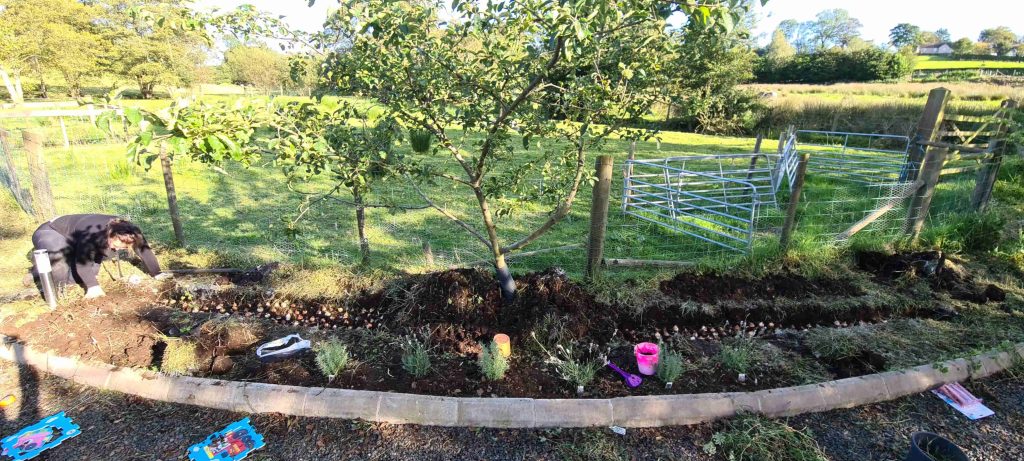
If you have a fruit garden, your bees already know about it. Apple, pear, cherry, plum — all of them flower in spring and all are worked eagerly by honey bees. The blossom is not a major honey source in the way that clover or heather can be, but it provides good early season nectar and pollen at a critical time.
There is also a useful relationship here that runs both ways. Your bees need the blossom. Your fruit trees need the bees. The pollination your colony provides to a fruit garden is worth far more in yield than any honey you might harvest. Beekeepers with fruit gardens tend to have very productive orchards.
We have blueberries, which flower in May, and they will be worked by the bees before the fruit forms. We are watching this with great interest and Bee Girl has already staked her claim to the harvest.
A Word About Oilseed Rape
If you have fields of oilseed rape nearby, your bees will be all over it in April and May. It produces nectar in huge quantities and a colony near a rape field can fill supers surprisingly fast.
The catch is that oilseed rape honey crystallises extremely quickly, sometimes setting solid in the comb before you can extract it. Beekeepers with rape nearby need to watch their supers closely and extract early. If rape honey sets in the frames it is almost impossible to remove without destroying the comb.
We do not have rape immediately on our doorstep. If you do, talk to your local beekeeping association about managing the timing of extraction. It is a gift and a complication in equal measure.
The Garden Centre Imposter: Cherry Laurel
You will see this everywhere. Big glossy evergreen hedging plant, often sold as wildlife friendly or good for pollinators. Grows fast, stays green all year, very popular for garden boundaries.
Cherry laurel (Prunus laurocerasus) has small white flowers in spring that bees occasionally visit. But it produces minimal nectar, the flowers are not a significant forage source, and the plant is so commonly used as a clipped hedge that it rarely gets the chance to flower at all.
More importantly, cherry laurel is invasive in Ireland and Northern Ireland. It self-seeds prolifically, spreads into woodland, and crowds out native plants that actually do feed bees. Planting more of it is not doing anyone a favour.
If you want a native evergreen hedge that does something for wildlife, look at holly instead. It flowers in May and June, the bees work it steadily, and it produces berries for birds in winter. Hawthorn itself makes a brilliant mixed native hedge. Both are better choices than laurel in every measurable way.
THE GOOD: Hawthorn in the hedgerows. May is the moment this country earns its keep for beekeeping. When the weather is right and the hawthorn flows, there is nothing quite like it.
THE BAD: Cherry laurel. Invasive, ecologically unhelpful, and barely useful to bees. There are so many better choices.
THE STICKY: Oilseed rape. Incredible nectar source. Sets solid in the comb if you blink. Ask us how we know. Actually, ask your local beekeeping association — they will explain it better and with less panic.
Part of The Bee Garden series. Next month: the two plants your bees will rely on more than anything else in summer, and one of them is probably already in your garden.
More bee garden posts: willow and dandelion in April and the best honey plants you already have. See also adding a second brood box.
Mum & Bee Girl x