
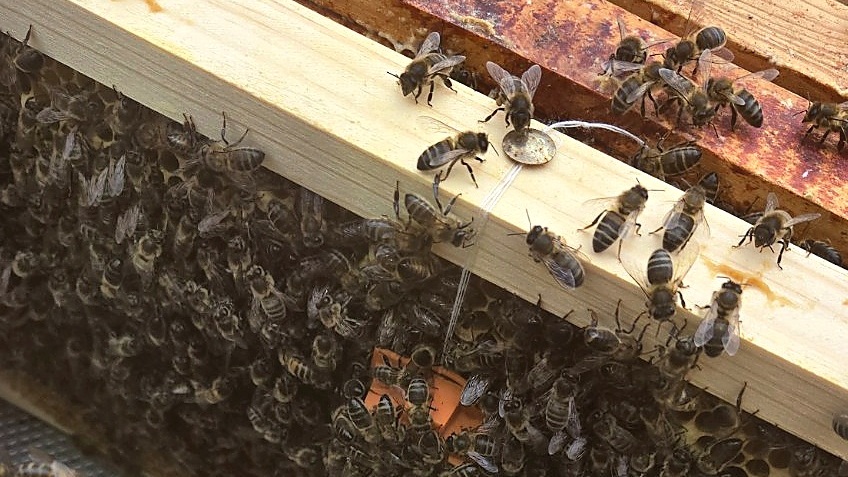
If you have been following along, you will know that we have had a season.
You can read the full version in How Do I Fix This but the short version is this: a hive that went queenless, a plan that went sideways, and two beekeepers standing at the apiary feeling considerably less confident than they had been in April.
This is what happened next: our first queen introduction, over three nervy visits.
Sunday: Bee Club and a Queen in a Box
We went to the bee club on Sunday.
Through the queen rearing group we have been attending, there was a mated queen available. A laying queen, healthy and ready to go. We collected her in her introduction cage with her attendant bees alongside her, all of them making the best of a small orange plastic situation.
She does not have a name yet. Clover is still in her nuc, still working on her mating flights. This queen is different. She came to us through the club. She is mated and proven and the queenless hive needed her more urgently than it could wait for anyone else.
So she came home with us on Sunday and went in on Monday morning.
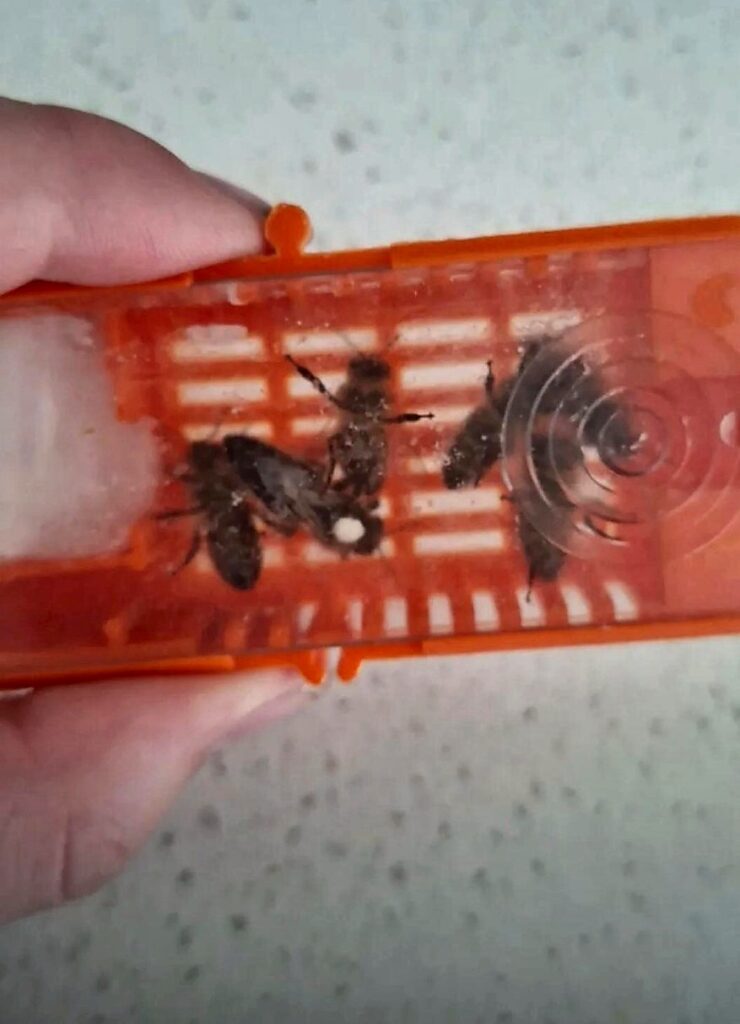
Monday: The Queen Introduction
The instructions were clear. Before you introduce a new queen, check the hive thoroughly for queen cells. Any queen cells present need to go before she goes in.
If the colony has already started raising their own queen and you introduce another one, the results are not good for anyone, and least of all for the queen in the cage.
We went through carefully. No queen cells. The hive was waiting.
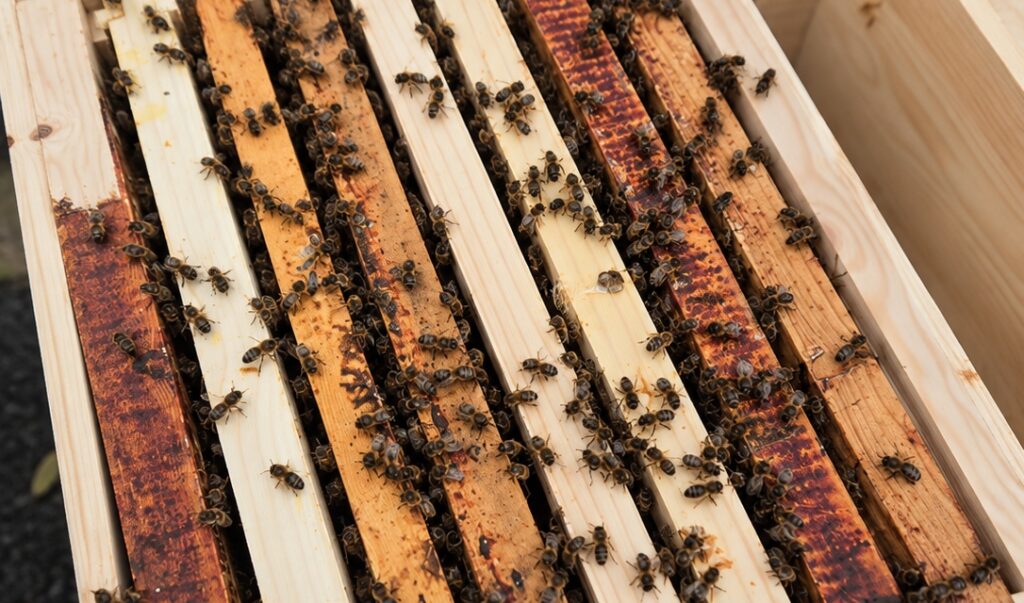
The introduction method is straightforward in principle. You place the caged queen between two frames so the colony can get used to her scent through the mesh before she is released.
The fondant plug in the cage means they have to eat through to reach her, which takes a few days and gives the pheromones time to do their work. By the time she is free, she smells like home.
Before suspending the cage, we placed it on top of the frames to read the workers’ reaction. This is your early warning system.
Balling behaviour, where bees pile onto the cage in a tight aggressive mass, means the colony is not ready to accept her and you do not go any further. What we saw was different.
The bees gathered around the cage with interest, antennae working, moving calmly. Keen, not hostile.
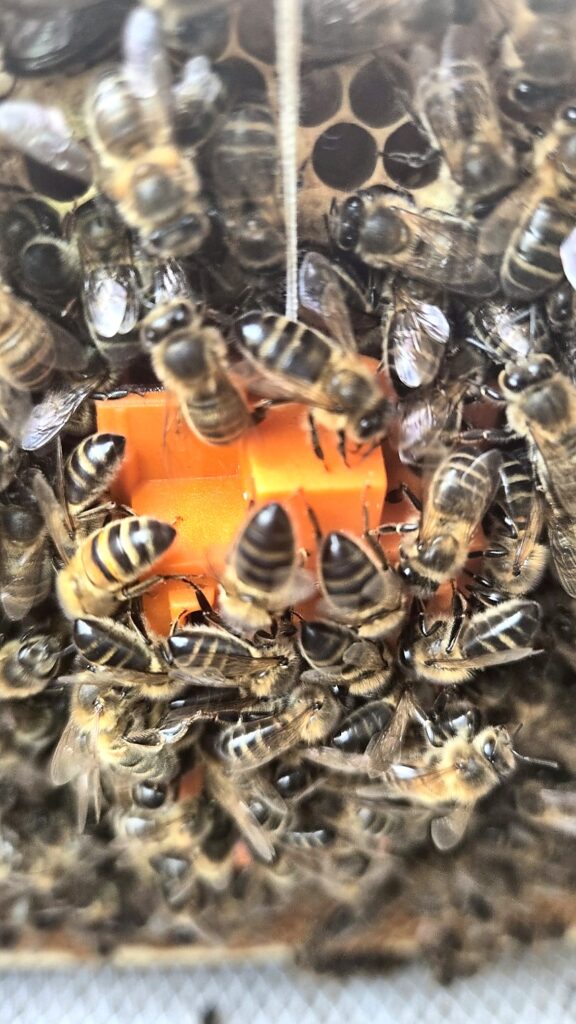
In she went.
Where I Got It Wrong
Here is where I have to tell you about the string.
The cage needs to be suspended between the frames so it hangs level in the gap.
The proper way to do this is with a cage that has lugs sitting on the frame top bars, or a matchstick threaded through the loop of the cage across the gap. Simple. Stable. Bees cannot chew through a matchstick.
I did not have a matchstick.
I used a pin through the lug of the frame and a length of string.
I want to be clear that this seemed entirely logical at the time. The instructions said suspend the cage. I suspended the cage. The cage was suspended.
What I had not considered, because nobody had ever mentioned it to me and it had not occurred to me to wonder, is that bees chew through string. Of course they do.
They chew through everything that does not belong in their hive. String absolutely does not belong in their hive.
I know this now. I did not know it on Monday.
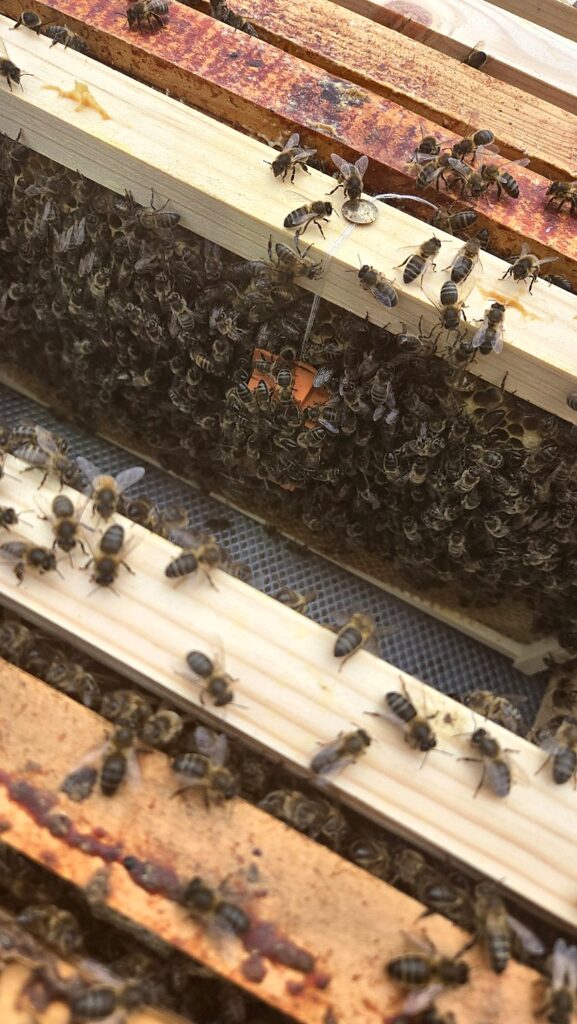
In she went, on her string, between the frames, with her fondant plug and her attendant bees. We closed up and went home.
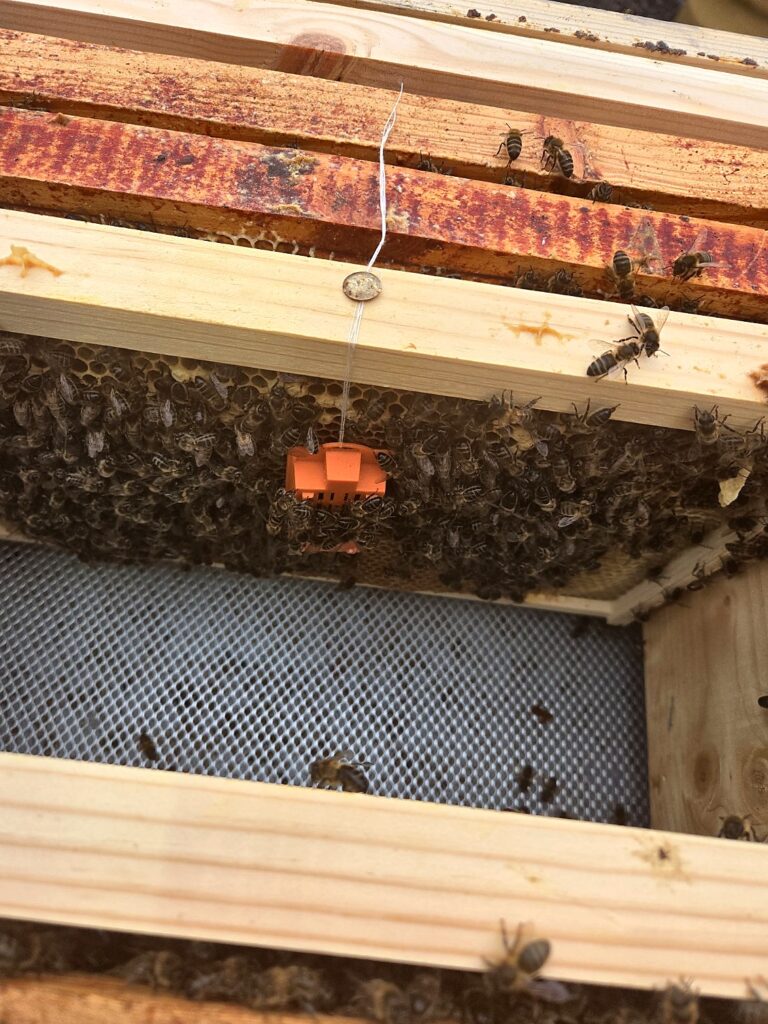
Thursday: Where Did She Go?
Three days later we went back to snap the plastic tab on the cage and give the colony the final stage of the release.
I lifted the crown board and looked for the cage.
It was not on the string.
The string was there. The pin was there. The cage was not.
I looked down at the mesh floor, which is where you look when something has gone wrong inside a hive, because that is where things end up.
She was not on the floor.
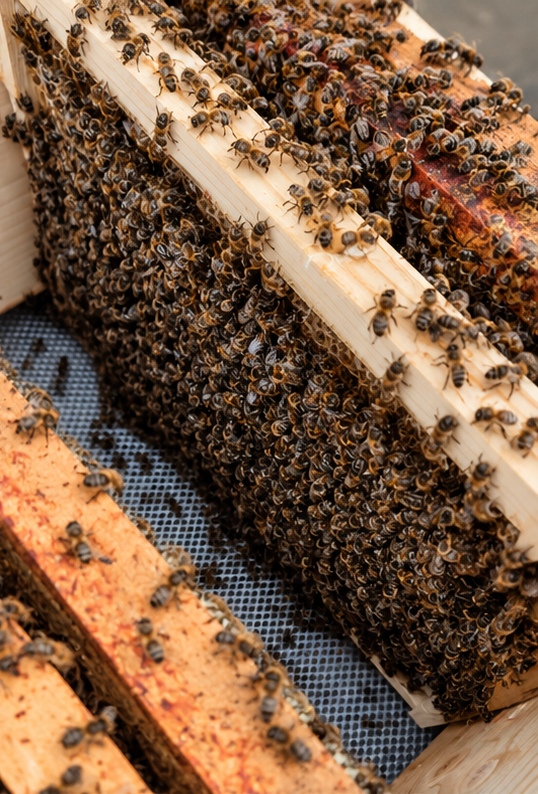
There was a specific few seconds between not seeing her on the string and not seeing her on the floor where I genuinely did not know what had happened to a queen we had been waiting two weeks for, in a hive that had been queenless for all of that time, that we had driven to the bee club to collect.
Where She Actually Was
Bee Girl was not panicking.
Bee Girl was looking at the frame on the other side of the gap, calmly, and then she said there she is.
The bees had chewed through the string. The cage had dropped and landed against the adjacent frame. And then, rather than letting it fall to the floor, the bees had built comb around it and held it in place themselves.
The cage was sitting embedded in fresh comb on the side of the frame, completely stable, completely attended, going nowhere.
The bees had fixed our mistake.
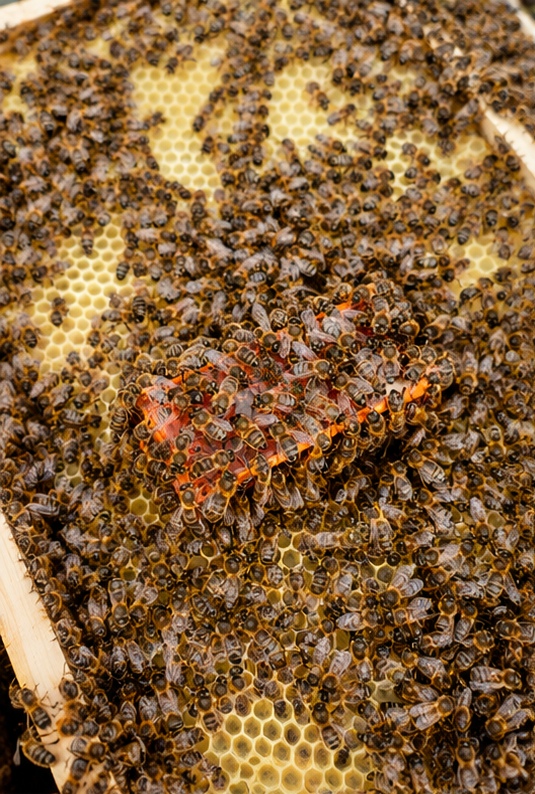
We removed the string and the pin carefully so as not to disturb her. We snapped the plastic fondant tab so the colony can eat through to her in their own time. We put everything gently back, closed up, and left them to it.
I stood there for a moment thinking about the string.
Note for anyone reading this who is planning a queen introduction: do not use string in a hive. The bees will chew through it. Use a cage with lugs that sit on the frame top bars. Use a matchstick through the loop.
Use anything that is not made of fibre. We got lucky. The bees compensated for our mistake because bees are considerably more competent than we are on our best days. Do not rely on that.
I have matchsticks now. They are in the beekeeping bag. They will stay there.
Where We Are Now
The plan is to leave them alone.
There is nothing useful we can do at the hive for the next couple of weeks. She needs time to settle, time to be accepted fully, time to begin laying. Opening the hive and being nosy will not help any of that.
The bees know what they are doing. Our job right now is to stay out of their way.
The other hive is a different story. I am still not entirely convinced there is no queen in there. When we go in, they are gentle.
They do not have that queenless feeling that a hive without a queen is supposed to have. She may be on a laying pause after everything that has happened this season.
I have been wondering whether I asked too much of that hive this year. A double brood box from the start, then a split, then the disruption of swarm season. Maybe she just decided enough.
Maybe she is taking a very reasonable break and will get back to us when she is ready. We are giving it another couple of weeks before we decide anything.
The wasps have found the apple trees which means the traps are going up next week. Keeping the wasp pressure down away from the hive is the most useful thing we can do while we wait.
Clover is still in her nuc. Still waiting on the weather. Her story is not finished either.
Two hives. Two situations we do not fully understand yet. One queen we can account for and one we cannot. That is beekeeping in June close to Slemish and we are getting used to it.
We will let you know how both of them get on.
The Good, The Bad, and The Sticky
The Good: The bees accepted her. Calm attendance on Monday, no balling, no alarm. On Thursday, rather than letting the cage fall when they chewed through the string, they built comb around it and held her safely in place. We did not deserve that level of competence from them. We are grateful.
The Bad: String in a hive. Do not do it. We have said what we have said.
The Sticky: Standing at the hive on Thursday with no queen on the string and no queen on the floor, trying to stay calm, and then Bee Girl pointing quietly at the other frame and saying there she is.
That is the whole blog in one moment. Bee Girl does not panic. Mum does. The bees sort it out. We write it down.
Mum and Bee Girl x